Foam rolling for legs: essential recovery tool or placebo?
You finish a hard squat session, walk out of the gym, and by the time you're in your car your quadriceps have that unmistakable heavy, brick-like quality. The next morning, every stair becomes a small negotiation with your own tissue.
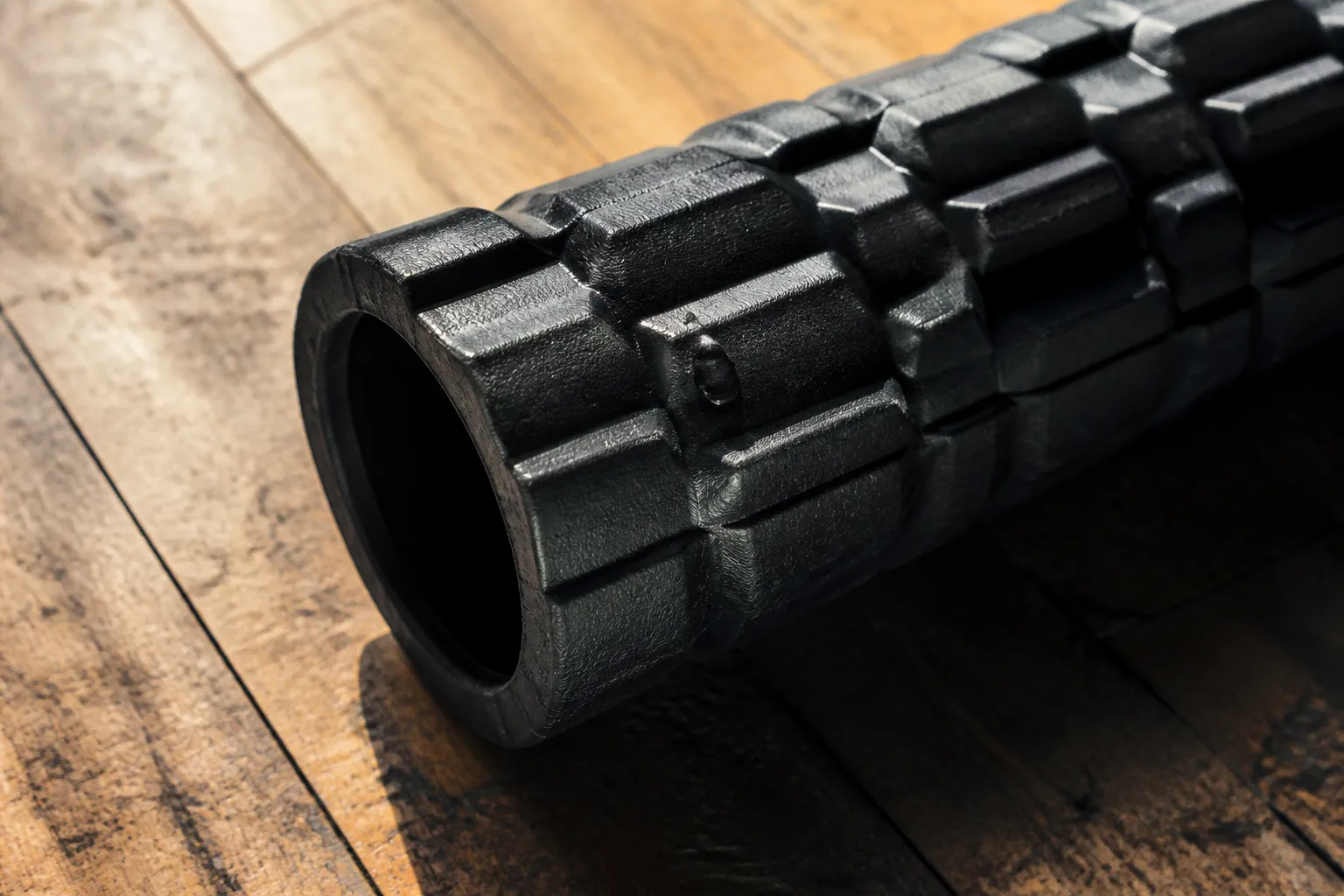
So you reach for the foam roller, lean in, and grind away at the soreness, hoping the cylinder beneath you is doing something more meaningful than just giving you a reason to wince. If you've ever wondered whether that actually works, or whether you've been paying forty dollars for a very elaborate placebo, you're asking exactly the right question, and the science has an answer that's more interesting than either camp usually admits.
The myth of myofascial release: what actually happens under the roller
For most of the past two decades, foam rolling has been sold to athletes on a very specific anatomical promise: that the pressure of the roller physically breaks up adhesions, lengthens fascia, and mechanically rearranges tissue. It is a tidy story, and a deeply satisfying one, because it suggests that soreness is a structural problem with a structural solution. Unfortunately, the structural story isn't really what the evidence supports.
What we now believe is happening is largely neurophysiological rather than mechanical. When you press a foam roller into a tender area of your quadriceps or calves, you are not "releasing" fascia the way you'd unstick a piece of tape. Instead, you're stimulating mechanoreceptors in the skin, muscle, and connective tissue, and that sensory input changes how your nervous system interprets the discomfort coming from that region. There are a few candidate pathways: diffuse noxious inhibitory control, in which one source of pressure-related input dampens pain signals elsewhere; descending pain modulation through the brainstem; and a quiet shift in autonomic tone that often accompanies slow, rhythmic self-massage.
Foam rolling doesn't rearrange your tissue — it talks to your nervous system about how much of that soreness you're allowed to feel.
This is why we say the effect is partly perceptual. That is not a criticism of the practice. The perception of soreness is the experience, and reducing it is a real, useful outcome. But it does change what foam rolling is, and isn't, a tool for. If your goal is to physically remodel muscle or fascia, the roller is the wrong instrument. If your goal is to feel less guarded and more willing to move through a stiff area, the roller is often exactly the right one.
Quantifying the recovery: what the numbers actually look like
Let's translate the mechanism into numbers, because the size of the effect matters more than its existence. The cleanest summary in the literature comes from a 2019 meta-analysis of 21 studies that looked specifically at post-exercise foam rolling. The findings were modest, but they were real, and the consistency across studies is what makes them worth trusting.
Here's what the data shows:
| Outcome | Effect from post-exercise rolling | Practical interpretation |
|---|---|---|
| Muscle pain perception (DOMS) | −6.0% | Small but noticeable reduction in next-day soreness |
| Sprint performance decline | Attenuated by 3.1% | Slightly less of the usual drop in short-burst speed |
| Strength performance decline | Attenuated by 3.9% | Modest protection against the strength loss that follows hard sessions |
| Flexibility (when rolled pre-exercise) | +4.0% | A small, real gain in range of motion |
| Pre-exercise sprint | +0.7% | Marginal, but useful as part of a warm-up |
Read those numbers honestly. None of them is going to transform your training. None of them is going to turn a destroyed set of hamstrings into fresh ones. But "small but real" is a meaningful category when you're an athlete trying to stack marginal gains, or when you're a recreational lifter trying to climb stairs without a grimace. The question is not whether foam rolling is magic. The question is whether a 6% reduction in soreness, paired with a 4% protection of strength, is worth the three minutes it takes you to do it. For most of us, the answer is yes, and the cost-benefit calculation is straightforward.
Pre-exercise vs. post-exercise: timing your rolling routine
One of the more useful insights from the recent literature is that the timing of your rolling changes what it does. Pre-exercise rolling — sometimes called pre-rolling — tends to behave more like a mobility primer than a recovery tool. It produces small improvements in flexibility (around 4% in the meta-analysis) and a marginal bump in sprint output, but it does not meaningfully change jump or strength performance in athletes who are already warm. If you use a roller before training, think of it as part of your nervous system's onboarding process for the session ahead, not as a substitute for the warm-up itself.
Post-exercise rolling is where the recovery story lives. The 2015 Pearcey study is the one most clinicians cite because the protocol was simple and the results were clean: twenty minutes of high-density foam rolling immediately after intense exercise, and then another round every twenty-four hours, reduced muscle tenderness and blunted the performance drop that delayed-onset muscle soreness usually causes. Twenty minutes sounds like a lot, and you don't need to do all of it on every muscle group. The principle is that brief, repeated exposure across the day tends to outperform one long session right after training.
If you only have three minutes, spend them on the quads and calves — that's where most recreational athletes notice the largest payoff.
There is also a small but interesting wrinkle. A 2023 crossover study on female basketball players looked at foam rolling after a single competitive match and found it was generally ineffective for metrics like countermovement jump height, heart rate variability, and next-day soreness. That doesn't contradict the meta-analysis; it just tells us that the size of the effect after a single, real-world competition is smaller than the tightly controlled lab protocols suggest. Foam rolling is a maintenance habit, not a rescue protocol.
Equipment matters: why cylindrical rollers outperform massage sticks
A surprising amount of the variability in outcomes comes down to the tool. In head-to-head comparisons, cylindrical foam rollers — the standard dense cylinder most people picture — produced a 5.6% improvement in strength recovery, while roller massage sticks and bars produced essentially nothing (−0.1%). That gap is not subtle, and it tells us something about how the pressure gets distributed.
A cylinder gives you a stable, predictable contact area. You can park your body weight on it, breathe into the tissue, and let the mechanoreceptor story do its work. A stick requires you to generate the pressure with your arms, which means the contact area is small, the force is variable, and the nervous system is paying more attention to your grip than to the muscle under the stick. For most recreational athletes, the practical takeaway is simple: if your budget allows one tool, buy a medium-density cylindrical roller somewhere between 30 and 45 centimeters long. Skip the vibrating rollers for now — the vibration adds sensory noise without reliably adding benefit — and skip the sticks unless you have a specific reason to use them.
Density is the second variable worth thinking about. A very soft roller is comfortable but tends to deform too much under your body weight to deliver useful input. A very hard roller delivers strong input but tends to provoke a guarding response, the kind where your nervous system braces instead of relaxes, and the analgesic effect drops off. The medium-density option is the Goldilocks zone for most of the leg, with a softer roller reserved for areas like the inner thigh and the front of the shin where the tissue is thinner and more reactive.
Beyond the roller: comparing rolling to active recovery and rest
This is the part of the conversation most foam-rolling marketing skips, and it's the part that matters most for your actual week. A 2025 study compared foam rolling, light jogging, and passive rest after intense exercise. All three methods reduced lactate buildup. None of them significantly outperformed the others. That's a quietly important finding, because it tells us that for clearing metabolic byproducts, the foam roller is not a superior technology — it's simply one of several reasonable options, and the difference between them is smaller than the marketing suggests.
What the roller does offer, that jogging and rest do not, is targeted input to the specific tissue that hurts. If your calves are wrecked, a ten-minute walk doesn't address them directly; it just moves blood around. A minute on the roller, by contrast, gives you focused, repeatable pressure on the tissue that needs it, and the analgesic effect tends to be local and specific. So the smartest framing is not "roller versus active recovery." It's "roller in addition to active recovery, when a specific area needs attention." We tend to think of recovery as a single thing, but your body is a collection of regions with different states, and foam rolling gives you a way to address one region at a time without spending your whole evening on the treadmill.
There is also a soft psychological layer that's worth naming without overstating. Slow, intentional rolling tends to put people into a calmer physiological state. Heart rate drops, breathing deepens, and the parasympathetic branch of the nervous system gets a little more room to operate. That state isn't unique to foam rolling — it's the state of any slow, body-focused ritual — but it is genuinely useful for athletes who live in a sympathetic, fight-or-flight training culture. You are, in a small way, teaching your nervous system that the work is done.
Where this leaves you
So is foam rolling for legs a legitimate recovery tool or an elaborate placebo? The honest answer is that it's a small, real, mostly neural intervention that does a few useful things modestly well. It reduces perceived soreness by about 6%, protects strength and sprint performance by a few percentage points when you're sore, slightly improves flexibility when used before training, and gives you a way to address one stubborn region without overhauling your whole routine. It does not physically rearrange fascia, it does not break up scar tissue, and it does not outperform light jogging for clearing lactate.
Used with realistic expectations — a few minutes on the quads and calves after a hard session, a medium-density cylindrical roller, a calm breathing pace, and the patience to let the nervous system catch up — it earns its place in your week. The athletes who get the most out of it are the ones who treat it as a quiet ritual rather than a performance hack. Listen to the joint, respect what the tissue is telling you, and let the roller do the small, real work it's actually good at.