Knee prehab exercises: a guide to joint stability
If you're reading this, there's a good chance your knee has been talking to you lately. Maybe it's a dull awareness on the stairs, a flicker of sharpness the morning after a longer run, or the small hesitation before you load a heavy suitcase into the car.
The reality behind that quiet knee
Knee prehab is the practice of listening to those signals early, and then quietly rewiring the muscles, tendons, and movement habits around the joint so that the next season of training doesn't end in a setback. It's not glamorous, and it isn't built around "bulletproofing" anything. It's built around the kind of movement literacy that lets you read your own body before it has to shout.
We see this pattern constantly in the clinic. The athlete who finally books an appointment after months of negotiating with a twinge. The recreational runner who cut a half-marathon short because the knee simply wouldn't settle on the downhills. In most of those cases, the joint itself is structurally sound. What failed was the system's ability to distribute force through it.
That's the frame we want to hold for this whole guide. The knee doesn't act alone. It sits between the hip and the foot, and it does its best work when both ends of that chain are doing theirs.
The biomechanics of knee resilience: beyond simple strengthening
When most people think about knee health, they think about the muscles that cross the joint — the quads, the hamstrings, maybe the calves if they're being thorough. Those muscles matter, of course, but the knee itself is fundamentally a hinge with a small rotational allowance, designed to flex, extend, and accommodate whatever the foot and hip decide to do. It is a translator of force, not a generator of it.
This distinction is the foundation of any serious prehab routine. If you only train the quadriceps in isolation, you're building a strong muscle that may still struggle to protect a joint that isn't being stabilized, aligned, or decelerated properly from above and below. Tissue tolerance is the combined capacity of muscles, tendons, cartilage, and nervous system control to absorb load without irritation. You can't build it by isolating a single muscle group. You build it by teaching the whole system to share work.
That's why effective knee prehab targets four regions: the quadriceps, the hamstrings, the calves, and the glutes. None of these work in isolation during running, lifting, or sport. They coordinate, and the knee is the meeting point.
The knee is less a generator of force and more a careful translator of it. Strengthen the neighbors, and the joint stops being the bottleneck.
There's another piece we should name directly: movement literacy. This is the practiced ability to notice where your knee is in space during a movement, to feel when it's drifting inward, and to correct that drift without having to think about it verbally. Movement literacy is what separates an athlete who can do a single-leg squat for 12 reps from an athlete who can do a single-leg squat for 12 reps while their knee stays centered over their midfoot the whole way down. We can train both, and we should.
Optimizing eccentric control with decline board training
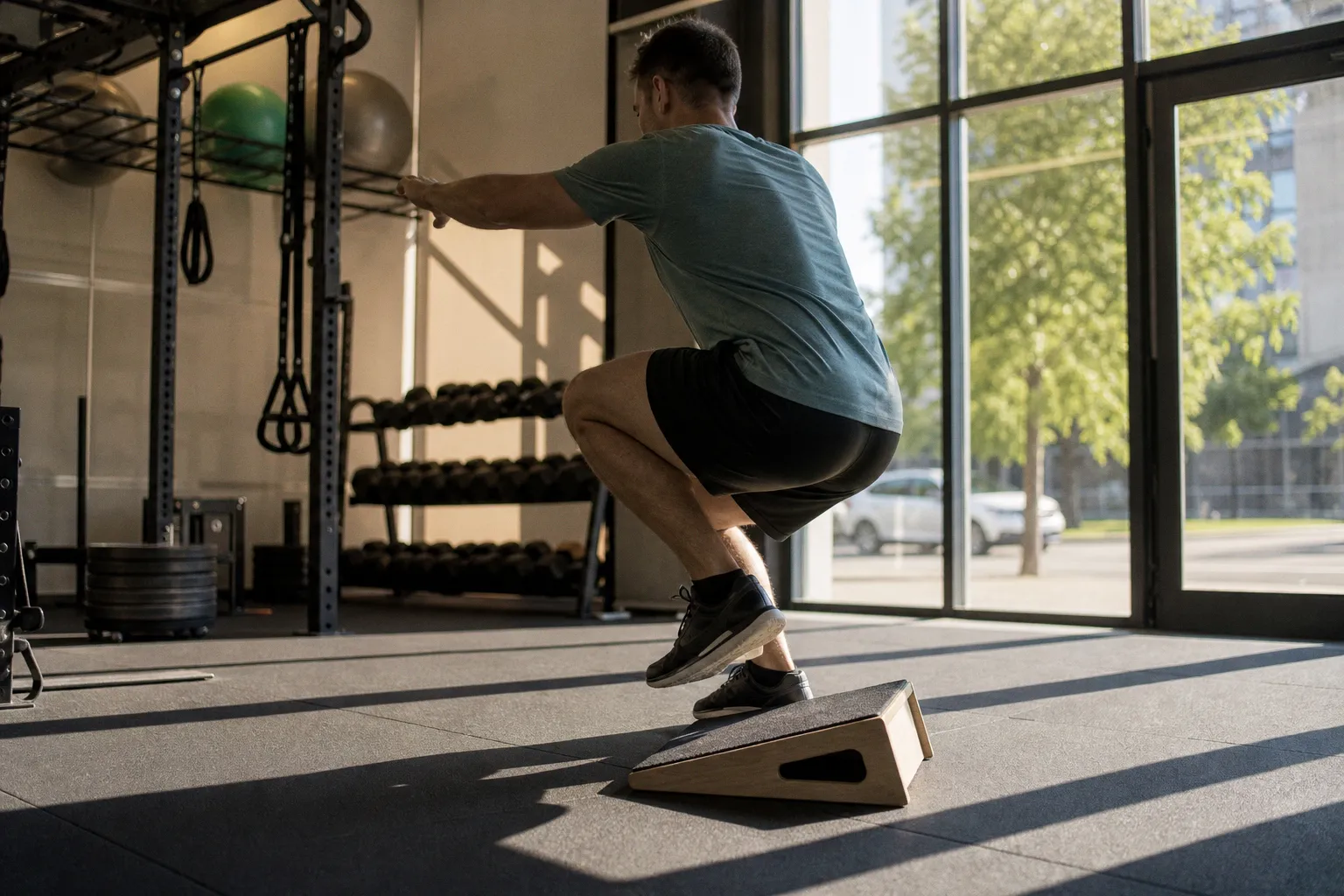
Of all the tools in a knee prehab routine, the decline squat has the longest track record in the research literature for one specific purpose: building tissue tolerance in the patellar tendon, the structure that connects your kneecap to your shin and absorbs enormous load during running, jumping, and decelerating.
The reasoning is biomechanical. When you perform a single-leg squat on a flat floor, the patellar tendon shares the load across a relatively long range of knee flexion. When you raise your heel on a decline board, you shift the working range of the knee into deeper flexion, and the tendon bears more of that load. This is exactly what we want when we're trying to strengthen it. Biomechanical work has shown that performing single-leg squats on a decline board at angles of 15° or higher increases the maximum patellar tendon force by around 40% compared to the same exercise on a flat floor. That's a substantial mechanical stimulus to the tendon, and it's why decline work has become a cornerstone of patellar tendonitis prehab.
But the deeper flexion range introduces another consideration. As the knee bends past about 60°, the contact forces between the kneecap and the underlying thigh bone — what we call the patellofemoral joint — rise steeply. For athletes dealing with patellofemoral pain, that diffuse ache behind or around the kneecap that flares on stairs and prolonged sitting, pushing into very deep flexion can be counterproductive, at least until symptoms settle.
So the practical framework looks like this. If your primary goal is patellar tendon loading, work in a moderate range, typically around 60° of knee flexion or slightly less, and use a decline board angled somewhere between 15° and 30°. If your kneecap is sensitive, stay shallower and prioritize control over depth.
One more nuance worth your attention. The traditional research protocol used a 25° decline board, and it produced reliable clinical improvements in patients with patellar tendinopathy. A more recent randomized comparison found that a 17° decline board produced equivalent clinical recovery and pain reduction. The takeaway isn't that one angle is "correct" — it's that you don't need to chase extreme angles to get a therapeutic effect. A moderate, well-tolerated setup, done consistently, beats a steeper angle you rush into.
Targeting the kinetic chain: why hip stability prevents knee valgus
If you watch a runner from behind as their foot strikes the ground, or a lifter descending into a squat, you'll often see the knee drift slightly inward toward the midline. This movement pattern has a name: dynamic knee valgus. It's one of the most consistent biomechanical risk factors for running-related knee pain, particularly in athletes with a history of patellofemoral issues.
The interesting thing about dynamic knee valgus is that it usually isn't a knee problem. The knee is being pulled inward because the hip — specifically the gluteus medius and the rest of the hip abductor group — isn't producing enough lateral stability to keep the femur aligned over the foot. The foot pronates a little, the tibia rotates inward a little, and the knee, caught in the middle, follows. The joint becomes the visible symptom of a problem happening upstream.
This is why any serious knee prehab routine includes hip strengthening. Two of the most accessible and well-studied exercises are:
- Clamshells. Lying on your side with knees bent and stacked, feet together, you rotate the top knee open while keeping the feet touching. The motion looks small, but it's loading the posterior gluteus medius in a way that's hard to cheat. Aim for controlled reps with a deliberate pause at the top.
- Side-lying leg lifts. With the bottom knee bent for stability and the top leg straight and in line with the spine, you lift the top leg a short distance and lower it under control. This trains the gluteus medius and the hip abductors through a more extended range.
Both exercises resist dynamic knee valgus indirectly. They don't load the knee itself in a way that aggravates symptoms, which makes them ideal for early-stage prehab when the joint may still be irritable. As the hip stabilizers get stronger, the knee starts receiving better-aligned force during running and lifting, and symptoms often settle not because the knee was treated directly, but because the inputs to it changed.
There's a broader payoff to this kind of integrated strength work that extends well past joint comfort. When experienced runners add structured strength training to their routine, research has documented improvements in running economy of around 4%, alongside measurable gains in VO2max and time to exhaustion. Those are systemic changes that ripple through the entire season of training.
| Region | Why it matters for knee prehab | Practical entry exercises |
|---|---|---|
| Quadriceps | Direct knee extensor; eccentric control decelerates the joint during landings and downhills | Decline single-leg squats, Spanish squats |
| Hip abductors / glutes | Control femoral alignment; resist dynamic knee valgus | Clamshells, side-lying leg lifts, single-leg step downs |
| Hamstrings | Assist knee flexion and posterior chain loading | Nordic curls, single-leg RDLs |
| Calves | Control tibial translation and pronation, absorbing ground reaction force | Straight-knee and bent-knee calf raises, supported stretching |
Debunking knee myths: functional movement and the "toes-over" rule
There's a piece of gym lore that has done more harm than almost any other to recreational athletes: the idea that your knees must never travel past your toes during a squat. The rule was meant to protect the joint, and it has instead produced a generation of athletes who lean their torso aggressively forward, lose their center of mass, and load their lumbar spine more heavily than they ever would have loaded their knees.
The research is actually quite settled on this. For most individuals, allowing natural knee travel over the toes during a squat is safe and can improve functional outcomes. The joint is designed to flex, and the patellar tendon and quadriceps are designed to tolerate the load that comes with deep, controlled flexion. The myth conflates "loading the knee" with "damaging the knee," which are not the same thing.
What does matter is whether the knee stays aligned with the toes as it tracks forward. A knee that drifts inward as it flexes is a different problem from a knee that travels forward over a stable foot. The first is a stability issue. The second is normal biomechanics.
This brings us to one of the most useful exercises for knee prehab: the single-leg step down, sometimes called the lateral step down. It looks simple. You stand on one leg at the edge of a step or low platform, and you slowly lower the opposite heel toward the floor while keeping the standing knee aligned directly over the toes. Then you return to the start.
What makes this exercise valuable is that it demands eccentric control of the quadriceps under a real, single-leg load, and it exposes any tendency toward dynamic knee valgus immediately. If your knee starts caving inward as you descend, you'll see it, and you'll feel it. That feedback loop is exactly what movement literacy is built from. Aim for somewhere between 8 and 12 controlled repetitions per leg, with the descent taking roughly two to three seconds, and prioritize alignment over depth.
Strategic calf conditioning for lower limb support
The calf complex is one of the most overlooked structures in knee prehab, and it's worth a few minutes of your routine. The gastrocnemius and soleus together form the primary spring system for the lower leg, and they absorb a substantial portion of the ground reaction force on every foot strike during running. When they aren't doing their job, that force transmits upward into the knee.
The first thing to understand is that the two muscles need slightly different things. The gastrocnemius crosses both the knee and the ankle, so to stretch it effectively, the knee should be straight. The soleus sits lower and crosses only the ankle, so to stretch it, the knee should be slightly bent. Holding each stretch for around 20 to 30 seconds, repeated a few times per session, is a reasonable starting point.
For strengthening, the pattern mirrors the stretching. Straight-knee calf raises bias the gastrocnemius; bent-knee calf raises bias the soleus. Adding both to your routine, ideally with some slow eccentric lowering, builds a calf complex that can handle more of the load that would otherwise drift up the chain to the knee.
There's a wider point here, too, and it connects to something we often discuss in recovery conversations: the difference between treating symptoms and building capacity. The athlete who stretches their calves for 30 seconds after a run is doing real tissue work. The athlete who pairs that stretching with bent-knee and straight-knee strengthening