Compare Knee Strap vs Sleeve for Patellar Tendonitis
Patellar tendonitis is not a knee problem in the broad sense. It is a load-tolerance problem at a specific tissue site.
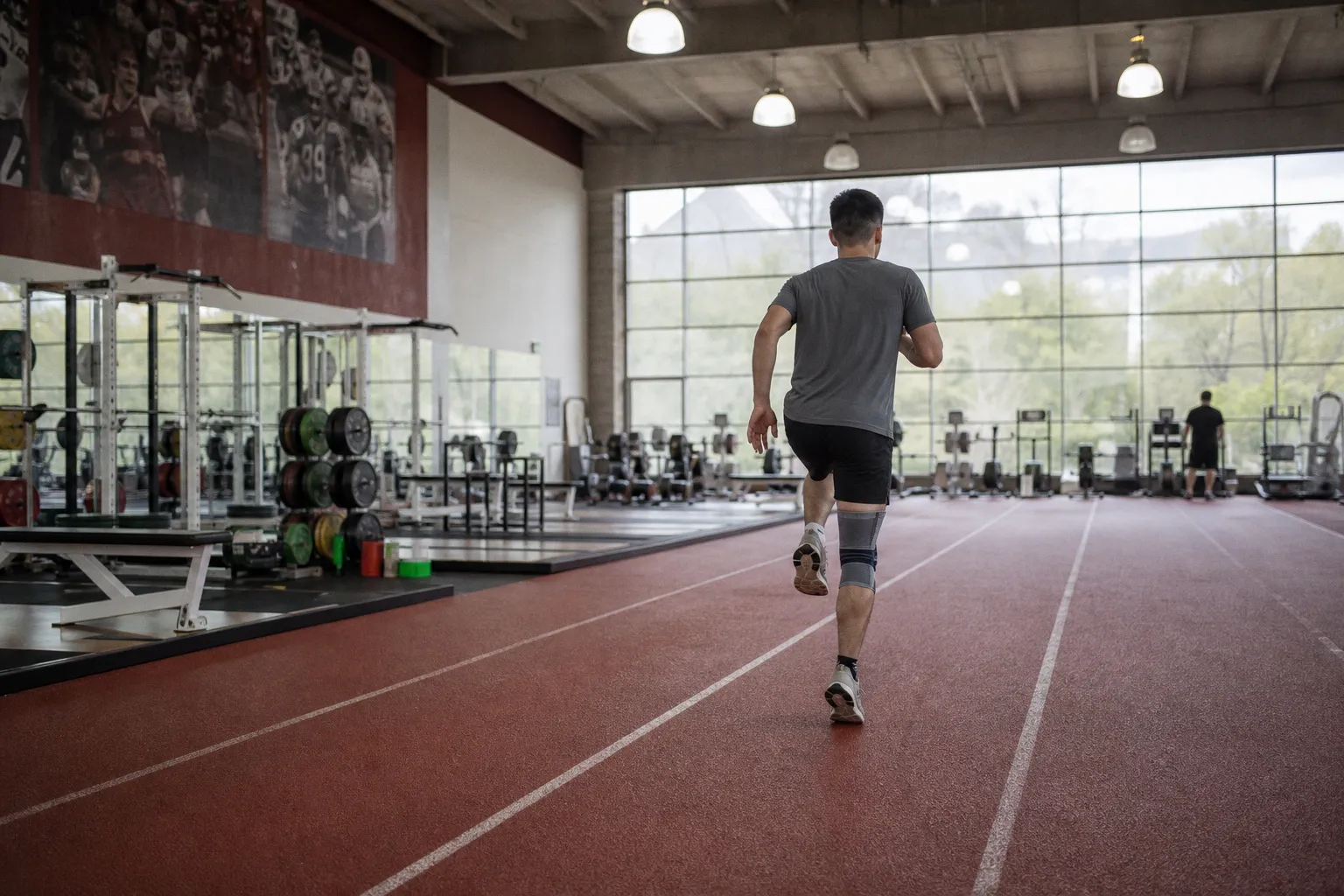
That distinction matters. A knee strap and a knee sleeve do not solve the same mechanical problem. One applies local pressure to the patellar tendon. The other applies joint-wide compression, warmth, and sensory input. If the question is how to check compare knee strap vs sleeve for patellar tendonitis, the answer starts with pain location, load behavior, and movement response. Not with product claims.
Mechanics of targeted pressure: what a patellar tendon strap actually does
An infrapatellar strap sits below the kneecap. Usually 1–2 inches below the patella. It applies pressure across the patellar tendon. That pressure can alter the angle of the tendon and change how force transmits through the painful region.
This is not healing. It is force modulation.
During a jump landing, squat, or running stride, the quadriceps produce force. That force transfers through the patella and patellar tendon to the tibia. The tendon does not “rest” during sport. It stores and releases energy. It tolerates load until the rate, volume, or magnitude exceeds current tissue capacity.
A strap attempts to change the local mechanics enough to reduce pain during that loading. It may reduce the perceived strain at the irritated tendon segment. It may let the athlete complete a controlled session with less pain. That can be useful when the training goal is exposure, not avoidance.
The strap is most relevant when the pain behaves like tendon pain:
- Pain is local. One finger can identify the site.
- Pain sits below the patella, not deep inside the joint.
- Pain increases with jumping, sprinting, stairs, or decline squats.
- Pain often warms up during movement, then returns later.
- Swelling is not the main feature.
- Instability is not the main complaint.
A strap is a narrow intervention. That is its value. That is also its limit.
A patellar strap is not a brace for the knee. It is a pressure tool for the tendon.
The common fitting error is placing it too low. If the strap sits on the tibial tuberosity or drifts down the shin, it stops acting on the tendon. If it sits directly over the patella, it stops being an infrapatellar strap. The pressure should cross the tendon just below the kneecap. Firm enough to stay fixed. Not tight enough to create numbness, skin blanching, or altered foot sensation.
The second error is using it to mask a failed session. If pain drops from 5/10 to 2/10 during warm-up, that may be acceptable for a modified workout. If pain drops only because the athlete tightens the strap until circulation changes, the device is no longer managing load. It is adding a new problem.
What a sleeve changes: compression, warmth, and proprioception
A knee sleeve has a different task. It covers the joint. It compresses soft tissue. It retains warmth. It increases proprioceptive feedback, meaning the nervous system receives more information about joint position and movement.
That can reduce pain perception. It can improve confidence. It can make the knee feel more stable during squats, lunges, and running drills. For athletes with mild swelling, general joint ache, or post-session stiffness, this may be useful.
But a sleeve does not target the patellar tendon with the same precision as a strap. It may influence symptoms. It does not meaningfully unload one tendon region by design.
Sleeves also vary. Compression levels are often described in mmHg, but brands differ and clinical superiority for patellar tendonitis has not been established. Material differences also get overstated. Neoprene, knit, and hybrid sleeves can all provide warmth and compression. No material should be treated as medically superior for patellar tendon recovery without evidence.
The sleeve fits the athlete who reports diffuse symptoms:
- The knee feels “full” after training.
- Pain is spread around the front of the knee, not fixed to one small tendon point.
- Mild swelling appears after running or court work.
- The athlete wants sensory feedback during lifting or return-to-running drills.
- The knee feels better once warm.
- Confidence is low during movement, but true mechanical instability is absent.
A sleeve can support training behavior. It often makes the athlete move with less guarding. That matters. Guarding changes kinematics. A runner with anterior knee pain may reduce knee flexion, overstride, or stiffen the landing. A lifter may shift load to the opposite leg. These changes distribute stress elsewhere.
A sleeve can improve perception. Perception influences movement. Movement influences load distribution.
Still, the sleeve is general. Patellar tendonitis is often specific. That is the central comparison.
Strap vs sleeve: the practical comparison
The decision is not “which is better.” That framing is too crude. The correct question is: which device matches the mechanical complaint during the session being performed?
| Parameter | Patellar tendon strap | Knee sleeve |
|---|---|---|
| Main action | Local pressure on the patellar tendon | Joint-wide compression and warmth |
| Best fit | Local tendon pain below the patella | General ache, mild swelling, need for proprioception |
| Mechanical target | Force distribution through the tendon | Sensory input and soft-tissue compression |
| Common use case | Jumping, running, stairs, decline squat pain | Lifting, warm-up, return-to-run confidence, mild effusion |
| Fit location | 1–2 inches below the patella | Covers the knee joint uniformly |
| Main limitation | Does not manage swelling or global joint symptoms | Does not provide targeted tendon unloading |
| Risk if misused | Masks excessive tendon load | Encourages dependency or false stability |
| Rehab role | Adjunct during controlled loading | Adjunct during movement exposure and symptom control |
This is the cleanest way to check compare knee strap vs sleeve for patellar tendonitis in an amateur setting: identify whether the pain behaves like a focal tendon load issue or a broader joint irritation issue.
For a recreational basketball player with pain during jumping and landing, localized below the kneecap, the strap usually matches the complaint better. For a recreational runner with vague anterior knee soreness and mild swelling after long runs, the sleeve may match better. For a lifter with patellar tendon pain during heavy squat sessions, either may help depending on the limiting symptom: tendon pain during depth, or general discomfort and stiffness during warm-up.
A device can reduce symptoms and still be the wrong primary intervention. That distinction prevents poor decisions.
Matching support to symptoms during training
A useful selection process starts before the product goes on the knee. It starts with a controlled symptom test.
Use a movement that reproduces symptoms without creating high risk. For many athletes, this is a bodyweight squat, step-down, or decline squat. For runners, it may be a short jog or controlled hop. The test should be repeatable.
Then compare three states:
1. No support. Record pain location and intensity. Note movement quality. Watch knee flexion, hip shift, trunk lean, and landing stiffness.
2. Strap. Place it below the patella. Repeat the same task. Do not change speed or depth.
3. Sleeve. Use the same task again. Keep warm-up conditions similar.
The result should be judged by function, not sensation alone. Pain reduction matters. So does movement quality.
A useful response looks like this:
- Pain decreases by at least a meaningful amount, not just a vague change.
- The athlete moves with less compensation.
- Pain does not spike after the session or the next morning.
- The device does not require excessive tightness.
- The athlete can still execute the planned load restriction.
A poor response looks like this:
- Pain is unchanged during the test.
- Pain shifts to another location.
- The athlete moves harder because the support creates false confidence.
- Symptoms increase later that day.
- The device becomes necessary for basic low-load tasks.
Patellar tendonitis reacts to total load. That includes intensity, volume, frequency, surface, footwear, and recovery spacing. A strap or sleeve can alter a single session. It does not erase the accumulated load history that produced the symptoms.
For athletes who want broader non-training reading between rehab blocks, general practical resources such as culture and everyday advice can be useful, but knee-support decisions should still be made from symptom behavior and load response.
The dependency trap: why support can become a problem
External support has a narrow job. It should help the athlete complete controlled exposure while the tendon adapts. It should not become the reason the athlete ignores pain progression.
Over-reliance on braces, straps, or sleeves can create dependency. It can also reduce the urgency to restore force production through the quadriceps, hip extensors, calf complex, and trunk. The tendon needs progressive loading. The kinetic chain needs capacity. The athlete needs tolerance across positions and velocities.
If the support becomes mandatory for all training, the program has failed to solve the underlying capacity problem.
This is especially common in amateur athletes because training loads are irregular. A runner may do two short runs, then a race effort. A court-sport athlete may skip strength work, then play three intense games. A lifter may deload for a week, then return to previous squat volume. Tendons dislike abrupt changes. They respond poorly to spikes.
Support devices can hide those spikes.
If the strap makes bad load management feel acceptable, it is not helping the tendon. It is improving the disguise.
A better rule: the support earns its place only if it allows a planned, reduced, measurable session. It should not permit an unplanned increase.
Do not use a strap to keep jump volume unchanged when pain has already appeared. Do not use a sleeve to make swollen knees feel warm enough for high-volume plyometrics. Do not use either as a substitute for rehabilitation work.
Load management remains the treatment base
Patellar tendonitis management is built on load management and strengthening. The support device sits outside that foundation.
The athlete needs to reduce provocative load enough to calm symptoms, then rebuild tendon capacity. This usually means controlling high tendon-load activities first: jumping, sprinting, hill running, deep knee-dominant lifting, and rapid deceleration. Complete rest is rarely the best long-term answer. Tendons need load. They need the correct dose.
A practical structure uses four categories.
1. Remove the obvious load spike
Find the recent change. Increased weekly mileage. More hill work. New court surface. Added plyometrics. More deep squats. Less recovery between sessions. Change in footwear. Return from illness. Tournament weekend.
The cause is often not one session. It is a jump in total demand.
Reduce the highest-irritation activity for 1–2 weeks. Keep lower-irritation conditioning if symptoms allow. Cycling, modified lifting, or flat easy running may be tolerated by some athletes. Others need stricter reduction. The tendon response decides.
2. Use pain rules with delayed response
Pain during exercise is only part of the data. Patellar tendon pain often reports later.
A working rule for many recreational athletes: symptoms during controlled rehab can stay low and stable. Pain should not climb through the session. Pain should not be worse the next morning. If morning pain increases, the previous load was too high.
The strap or sleeve should be tested against this delayed response. A good session with a bad next morning is still a bad session.
3. Rebuild force production
Quadriceps capacity matters. So does hip and calf contribution. The tendon works inside a system.
A basic progression may include:
1. Isometric knee-extension or wall-sit variations. Use tolerable angles. Hold steady tension. This can reduce pain for some athletes and maintain force production without high tendon strain rates.
2. Slow resistance work. Leg press, squat variations, split squats, or knee-extension work. Tempo controls load. Range can be adjusted.
3. Heavy slow resistance when tolerated. Tendon adaptation requires meaningful load. It does not require reckless load.
4. Energy-storage work. Skipping, hopping, low-level plyometrics, then sport-specific jumping or running intensity. This comes later.
5. Return to reactive sport. Cutting, landing, acceleration, and repeated jumps. Volume is measured. Recovery is planned.
The strap may stay in during selected phases if it reduces symptoms without changing mechanics negatively. The sleeve may stay in if it improves confidence and warmth without encouraging extra volume. Neither replaces the progression.
4. Control kinematics under fatigue
Patellar tendon load is affected by movement strategy. Excessive knee-dominant landings, poor hip contribution, stiff ankle mechanics, or rapid increases in landing volume can raise tendon demand. The issue is not that knee flexion is bad. Knee flexion is required. The issue is whether the athlete has capacity for the force being produced and absorbed.
Video can help. Side and front views are enough for basic review. Look for:
- Overstriding during running.
- Heavy braking on landing.
- Knee collapse paired with poor hip control.
- Asymmetry during squats or step-downs.
- Reduced ankle dorsiflexion causing compensation.
- Sudden technique loss under fatigue.
A support device may improve perceived stability. It will not correct poor load distribution by itself.
When the strap is the better choice
Choose the patellar tendon strap when the complaint is focal and tendon-like. The athlete can point to the inferior patellar region. The pain appears with tendon-loading movements. The knee does not present as globally swollen or unstable.
Useful cases include:
- Jumper’s knee during basketball, volleyball, or tennis.
- Pain during stairs or decline walking.
- Pain during squat descent or ascent near the patellar tendon.
- Return-to-run sessions where focal tendon pain limits volume.
- Controlled plyometric reintroduction where symptoms need modulation.
The strap should be treated as a session tool. Put it on for the relevant work. Remove it after. Track whether total symptoms improve over weeks. If it only helps while worn and baseline symptoms do not change, the rehab plan needs revision.
The strap is not ideal when pain is diffuse, swelling is present, or the knee has multiple symptom sites. It is also a poor fit when the athlete cannot tolerate local pressure over the tendon. Pain from compression is not a useful treatment effect.
When the sleeve is the better choice
Choose the sleeve when the athlete needs joint-wide compression, warmth, and proprioceptive input. This is more likely when symptoms are broad rather than focal.
Useful cases include:
- Mild swelling after training.
- General anterior knee ache without one clear tendon point.
- Stiffness during warm-up.
- Low confidence during controlled lifting.
- Return to movement after a period of reduced activity.
- Sessions where warmth and sensory feedback improve mechanics.
A sleeve can be useful in strength sessions because it changes perception. The athlete may settle into depth with less guarding. It can also help during easy running in cold conditions if stiffness changes stride mechanics.
But for true patellar tendonitis, the sleeve may be secondary. It may make the knee feel better without reducing focal tendon load enough to matter. The athlete should test it against the same movement used for the strap. If pain remains focal and unchanged, the sleeve is not the correct tool for that symptom.
Can an athlete use both?
Sometimes. But the reason must be clear.
A sleeve plus strap can provide joint-wide compression and local tendon pressure. That may help in a return-to-sport phase. It can also create too much compression, poor fit, heat, slipping, or altered movement. More equipment does not equal better mechanics.
Use both only if each adds a measurable benefit:
- The sleeve reduces stiffness or improves confidence.
- The strap reduces focal tendon pain.
- Combined use does not increase pressure symptoms.
- Movement quality improves or stays stable.
- Next-day symptoms do not increase.
If the athlete needs both for every session, reduce load and reassess. Equipment stacking often signals that training demand exceeds tissue capacity.
A simple decision protocol
Use this sequence before buying or relying on support.
1. Map the pain. One-finger pain below the patella points toward a strap trial. Diffuse ache or mild swelling points toward a sleeve trial.
2. Choose one repeatable test. Step-down, squat, decline squat, short jog, or low hop. Keep it consistent.
3. Test no support, strap, and sleeve separately. Do not compare different workouts.
4. Track pain during and after. Include next-morning response.
5. Keep the device only if it improves function without increasing load. Symptom reduction must not lead to unplanned volume.
6. Build the rehab around strengthening. Isometrics, slow resistance, progressive loading, and later energy-storage work.
7. Reduce support over time. The goal is not permanent external support. The goal is restored tendon capacity.
This answers the amateur version of how to check compare knee strap vs sleeve for patellar tendonitis: test the device against a controlled task, then judge by mechanics and delayed tendon response.
Final position
A knee strap and a knee sleeve are not interchangeable. The strap targets the patellar tendon with localized pressure and may reduce focal tendon pain during loading. The sleeve provides compression, warmth, and proprioceptive feedback across the knee and may help with general ache, mild swelling, and confidence.
For patellar tendonitis, start with the pain map. Focal pain below the patella favors a strap trial. Diffuse discomfort or swelling favors a sleeve trial. Use the device only as an adjunct.
The treatment priority does not change: reduce load spikes, preserve force production, rebuild tendon capacity, and return to elastic work in measured steps. Support is allowed. Dependency is not.
FAQ
How do I know if I should use a strap or a sleeve for my knee pain?
Where exactly should a patellar tendon strap be placed?
Can wearing a knee sleeve help heal patellar tendonitis?
Is it okay to wear both a strap and a sleeve at the same time?
What is the main risk of using a knee strap during exercise?
By Duncan Reed