Differential effects of plyometric training loads on jump and sprint performance reveal optimal strategies
You know that heavy-legged feeling after a week of jumps, sprints, cuts, and “just one more” conditioning block — when the body is not injured, exactly, but the spring feels a little less springy?
Elaine Summers·updated July 08, 2026
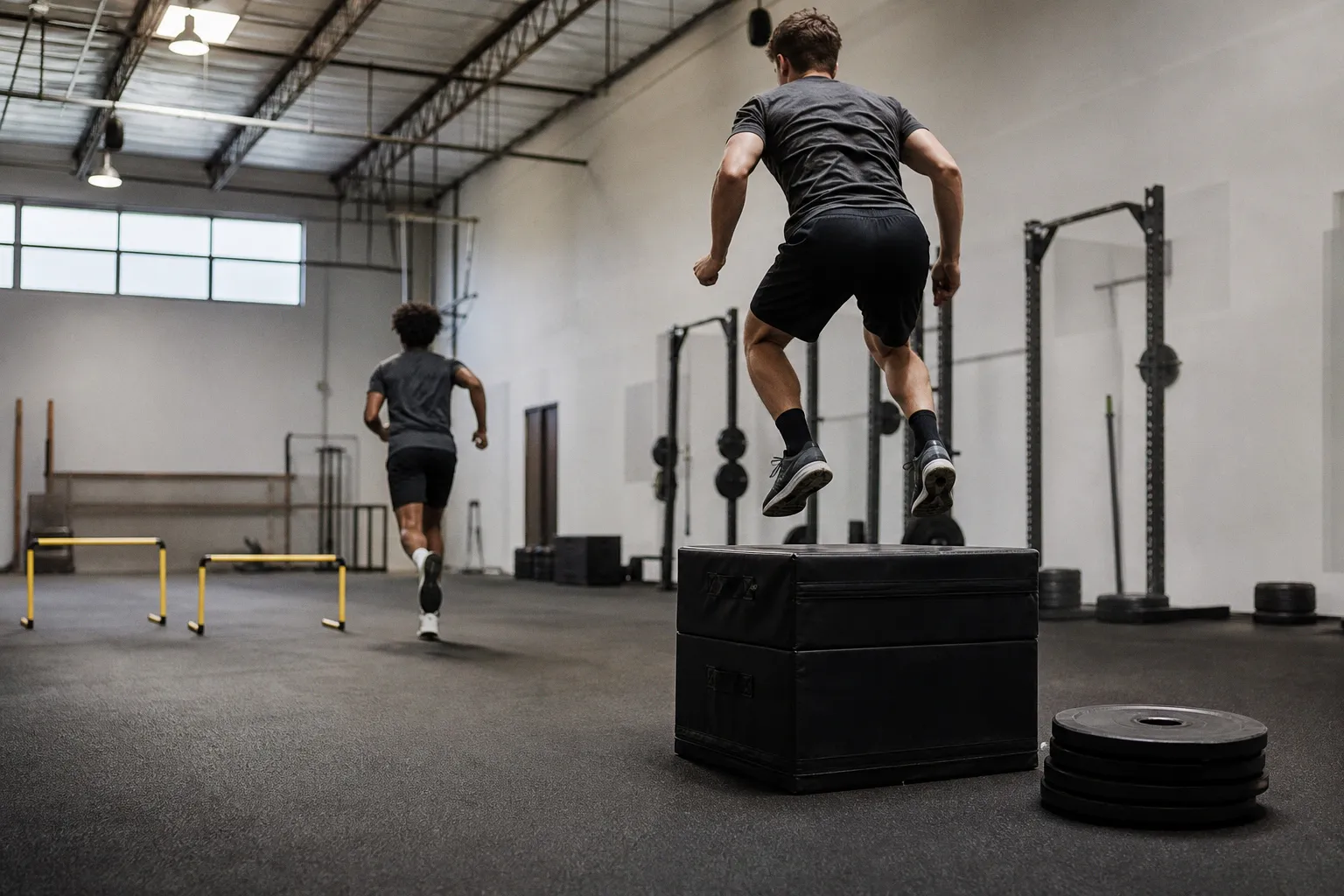
Plyometrics are not one bucket of “explosive work”
The Nature headline is narrow but useful: “Differential effects of plyometric training loads on jump and sprint performance reveal optimal strategies.” We do not have the full study details here, so we should be careful not to turn a headline into a prescription. But even that framing is worth paying attention to for everyday athletes, because it challenges a common shortcut: assuming that more jumping automatically means better jumping and faster sprinting.
In clinic and on the training floor, we often see plyometrics treated as a single ingredient — box jumps, bounds, hops, pogos, depth landings — added wherever the program has room. The body reads that more specifically. Jump performance asks a lot from vertical force production and landing tolerance. Sprinting asks for rapid stiffness, rhythm, projection, and the ability to put force into the ground at speed. Those qualities overlap, but they are not identical.
So the practical takeaway is not “do a certain number of contacts,” because that number is not confirmed in the available source. It is this: if your goal is to jump better, sprint better, or simply feel more elastic during sport, the load of plyometric work should be matched to the quality you are trying to improve — and to the tissue tolerance you currently have. Calves, Achilles tendons, knees, hips, and the low back all participate in this conversation. When they start answering with persistent heaviness, sharpness, or a loss of coordination, that is feedback, not failure.
The surface is part of the workload, too
A separate industry discussion at the 77th Annual NATA Clinical Symposia and AT Expo in Philadelphia focused on a related issue: athletic trainers are managing athlete health and availability while training loads, game schedules, and year-round competition continue to increase. In that setting, TenCate highlighted turf technology, including a rubber-free system called Pivot Performance Turf, as part of a broader conversation about athlete health, recovery, and surface consistency.
The company’s point was that athletic trainers already think about workload, movement, fatigue, and confidence — and that the field beneath the athlete is another variable. TenCate described Pivot as an infill-free turf system intended to reduce one source of variability by removing the loose rubber layer used in many traditional synthetic fields. The system was presented as designed to feel and respond more consistently under repeated use, including during planting, cutting, sprinting, decelerating, landing, and pushing off again.
For recreational athletes, this does not mean we should suddenly blame every sore joint on the field. That would be too neat. But it does give us a better movement-literacy lens. A sprint session on a predictable track, a cutting drill on worn turf, and repeated jumps on a hard indoor surface may all sit differently in the body, even if the workout looks similar on paper. The ankle may have to organize force differently. The knee may receive braking load differently. The hip may need to contribute more when the foot-ground interaction feels less predictable.
Listening to the joint, in this case, includes listening to the environment.
What to watch in your own training week
The most useful adjustment is usually not dramatic. If you are adding plyometrics, sprint work, or more court and field time, avoid stacking all the highest-impact work into the same small window simply because your schedule is busy. Keep an eye on how your first few landings feel, whether your stride still has rhythm, and whether soreness is fading in a normal way or lingering into the next quality session.
If your program includes both jumping and sprinting, it may help to separate the intent of each session: some days are about crisp, elastic contacts; some are about acceleration; some are about strength or mobility that supports those qualities. This is where “optimal” becomes less of a magic formula and more of a fit between goal, dose, surface, and recovery.
The emerging theme across these reports is not that athletes need to be cautious about movement. It is that explosive training works best when we respect how many variables the body is integrating at once. Load matters. The ground matters. Fatigue matters. And over time, the athletes who progress well are usually the ones who build capacity patiently enough for the tissues to keep saying yes.