Build muscle that lasts with smart training
A study in Frontiers in Physiology compared two complex training modalities in competitive swimmers.
Duncan Reed·updated July 08, 2026
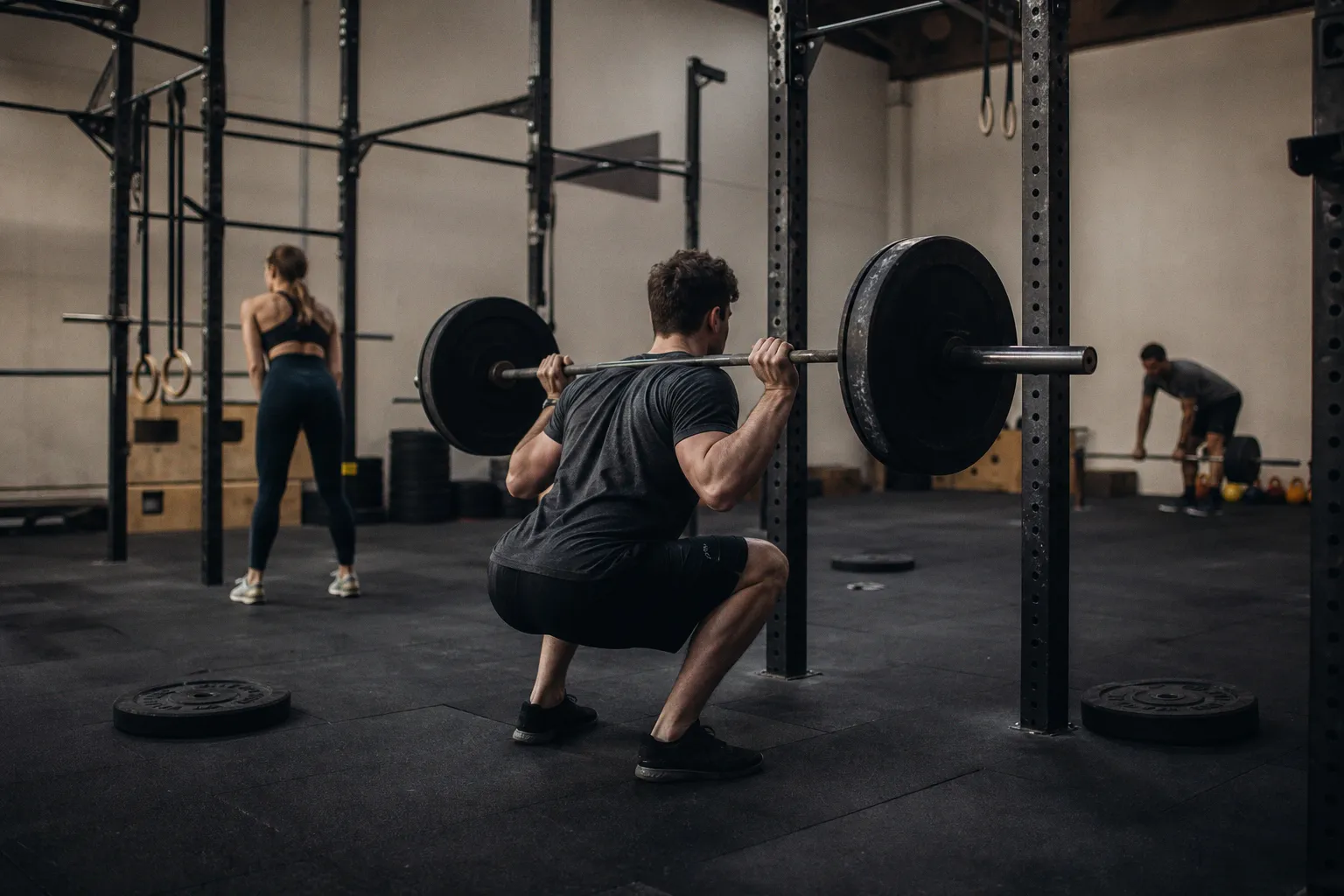
Variable resistance cuts rest, maintains force output
A study in Frontiers in Physiology compared two complex training modalities in competitive swimmers. Variable resistance complex training (VRCT) produced strength and power gains comparable to traditional heavy-load methods—while using shorter rest intervals and lower absolute loads. For the recreational athlete managing limited gym time, the protocol offers a proven way to compress sessions without sacrificing adaptation.
The study design
Twenty-four male swimmers completed a six-week intervention, training twice per week. Both groups alternated high-load resistance exercise with plyometric movement within the same session. That structure—known as complex training—exploits post-activation potentiation: a heavy lift primes the neuromuscular system, making the subsequent explosive drill more effective.
The VRCT group loaded at 70% of 1RM plus 0–23% from elastic bands. Rest between paired exercises: 90 seconds. The traditional complex training (TCT) group worked at 93% of 1RM with four-minute rest intervals. Both protocols drove significant increases in back squat 1RM, countermovement jump height, and squat jump height (p < 0.01 for all). Both groups also improved turn time and 100-m sprint time.
One difference stood out. The VRCT group showed significantly greater gains in start and turn time compared to the control group (p < 0.05). The TCT group did not reach that threshold for start time. Variable resistance—where band tension increases through the concentric range—maintains force production demands at shorter, more practical rest periods.
Load management and time efficiency
The mechanical logic is straightforward. Traditional complex training near 90% 1RM demands long recovery windows to preserve bar speed and movement quality on the plyometric component. Variable resistance at 70% + band tension approximates similar peak forces at the top of the range of motion, but the mean load is lower. The system recovers faster. Rest drops from four minutes to ninety seconds.
Over a full session, that difference compounds. A typical complex pairing repeated across three to four sets saves eight to twelve minutes of standing time. For the athlete balancing training with work and family commitments, that margin determines whether the session happens at all.
The strength-endurance coupling also matters. Competitive performance—in any sport—rarely demands a single maximal effort. The 50-day countdown to the 2026 World Cup offers a reminder: athletes preparing for peak competition windows need protocols that build power under fatigue, not just in fresh conditions.
Translating the protocol to general training
The study population was trained swimmers. Generalization requires caution. The underlying mechanism—complex training with variable resistance—applies across movement patterns, provided the athlete has baseline proficiency in both the strength and plyometric exercises.
A practical template for the recreational athlete:
Paired set structure: Perform a heavy compound lift, rest 60–90 seconds, perform a biomechanically similar explosive movement. Examples: back squat paired with vertical jump; bench press paired with medicine ball chest pass; Romanian deadlift paired with kettlebell swing.
Variable resistance loading: Use bands or chains to add 10–25% of the bar load at lockout. Start at 65–70% of bar 1RM. Total peak load should approach 85–95% 1RM at the top of the range.
Session structure: Three to four pairings. Two to three sets per pairing. One to two sessions per week. Maintain this for a four-to-six-week block before reassessing load.
What to track: Rest interval compliance first. If the athlete cannot maintain movement quality at 90 seconds, extend to two minutes and reduce band tension. The goal is force production at speed—not grinding through fatigue with compensatory mechanics.
The study confirms what force-velocity curve research has suggested: manipulating resistance profile matters as much as manipulating absolute load. A band at 70% bar load can demand the same joint-level forces near extension as a straight bar at 90%—but with less systemic fatigue and shorter recovery. That trade-off favors the time-constrained athlete pursuing durable strength gains over maximal singles.