Ten-Minute Workout and Chronic-Disease Guidelines: Why the Fitness Industry Is Remaking Itself
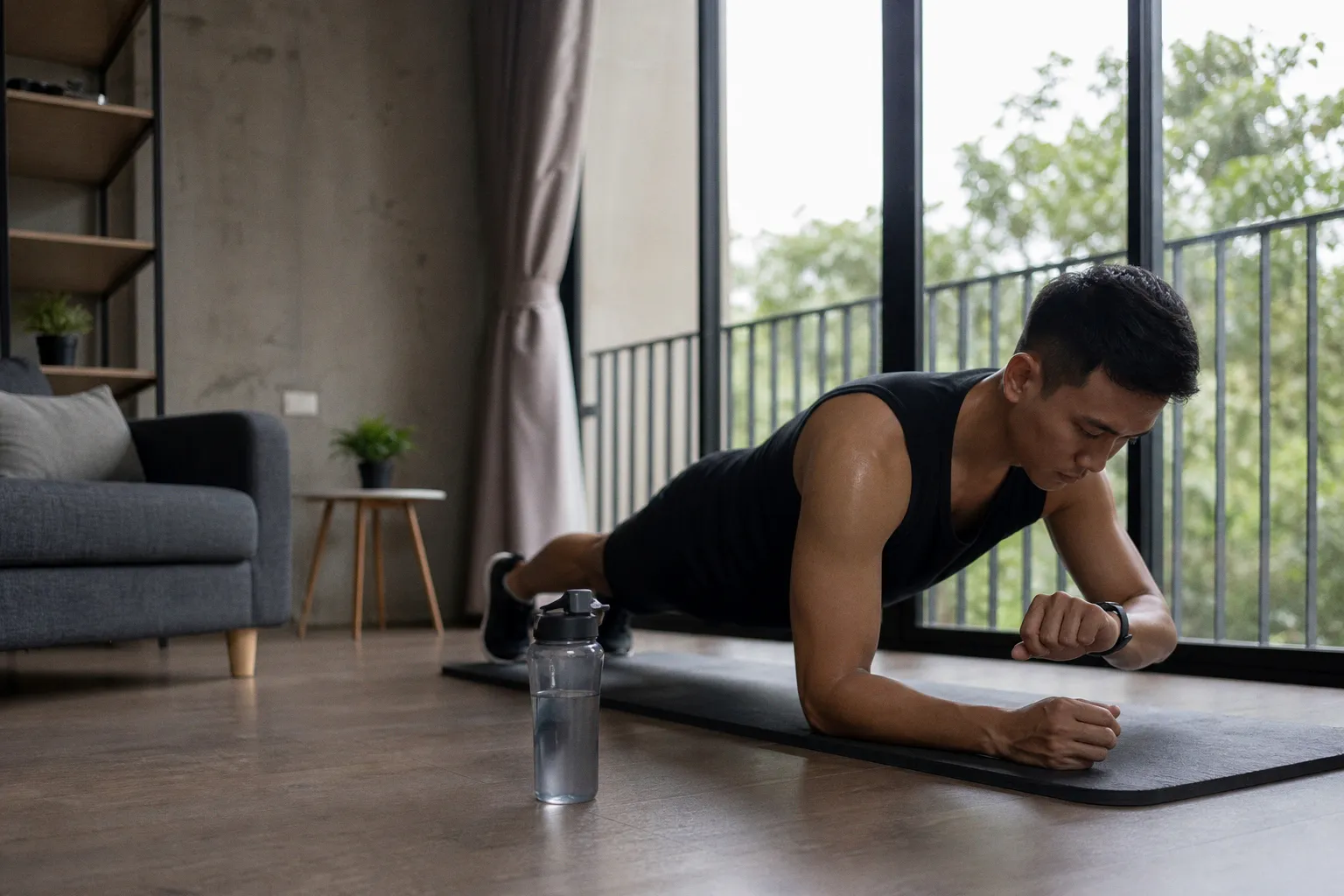
A ten-minute session changes the entry cost of training. AD HOC NEWS reports that a beginner full-body workout, with no equipment, has been available since early July and is built around functional movements such as squats and push-ups.
Duncan Reed·updated July 06, 2026
The dose is getting smaller, but the structure matters
The reported ten-minute format is not a shortcut to performance. It is a low-friction exposure to force production.
Trainer Tobias Lipp recommends two to three sessions per week. That matters more than the duration. A beginner does not need fatigue. A beginner needs repeatable mechanics: hip flexion, knee tracking, trunk stiffness, scapular control, and controlled pushing volume.
For related context, see High-rep training and recovery tools reshape fitness trends.
The exercise selection described by AD HOC NEWS — squats and push-ups — fits that use case. Both movements expose the system to basic loading patterns. Squats test ankle, knee, and hip coordination. Push-ups test anterior chain stiffness and shoulder control. No equipment reduces the barrier, but it also removes external load. Progression must then come from tempo, range of motion, density, or exercise variation.
The platform behind the workout, fitnessRAUM.de, is described as offering more than 2,500 courses. Its internal surveys report a 62 percent reduction in physical inactivity, a 60 percent drop in muscular tension, and a 44 percent decrease in stress levels among members. Treat those as internal data, not clinical proof. Still, they point to the same operational issue coaches see daily: adherence improves when the first session is small enough to repeat.
Prevention is moving into policy, not only apps
The same AD HOC NEWS report points to a broader shift. Many German health insurers now cover prevention courses in full. The regional government of Trentino has adopted operative guidelines for adapted physical activity, or AFA, aimed at people with chronic illnesses. The framework uses group exercise in outpatient, non-clinical settings.
That is a different model from the standard gym narrative. It does not start with transformation. It starts with load management.
For people with chronic conditions, the training problem is not intensity alone. It is matching stimulus to tolerance, then repeating it without symptom escalation. Group formats can help if they control movement options, rest periods, and progression. They can fail if they treat all participants as the same mechanical system.
The source also notes rising demand in Pilates and fascia-training formats, including a new reference book by Stefanie Rahn and Christian Lutz that organizes 50 Pilates exercises by difficulty. That ordering is useful. Difficulty grading is not decoration. It is a progression tool. It lets a coach move from mobility and low-load control toward higher coordination demand without guessing.
Outdoor and public formats are also expanding. Rucking is described as a joint-friendly alternative to jogging, with a recommended load of five to ten percent of body weight. Freiburg evaluated 13 calisthenics stations, suggesting more public infrastructure for bodyweight training. These are not equivalent stimuli. Rucking loads gait. Calisthenics loads leverage and joint angles. Both require progression rules.
The industry has goodwill. Trust is the limiting factor
Athletech News reports that fitness and exercise scored 78 out of 100 in a Washington policymaker reputation survey, ranking ahead of tech, automotive, hospitality, pharmaceuticals, health insurance, and hospital systems. The Health & Fitness Association also described joint work with the Department of Health and Human Services and the Department of Defense on a voluntary program offering free gym access and optional coaching to recruits.
That is institutional momentum. It does not solve the trust problem.
According to the same report, 55 percent of policymakers believe the industry is committed to fair and transparent membership practices. Forty-four percent agreed that the industry makes it hard to cancel or change a membership, and only 10 percent disagreed. Among the general public, roughly two-thirds say canceling a gym membership is too hard.
For training outcomes, this is not a side issue. A person who feels trapped by a contract will not treat a facility as health infrastructure. They will treat it as a liability. Preventive exercise requires continuity. Continuity requires trust. The best programming model cannot compensate for a business model that creates friction at the exit.
For now, the practical protocol is simple.
Use the ten-minute model as a baseline, not a ceiling. Run two to three sessions per week. Select one squat pattern, one push pattern, one hinge or hip-control pattern, and one trunk-control drill. Stop each set before technique breaks. If using rucking, start with five percent of body weight, not ten. If managing tendon pain, follow the reported 24-hour rule for eccentric calf raises: if next-morning pain increases, reduce intensity. If choosing a course, check progression, instructor qualification, cancellation terms, and whether the session has a clear regression for your current capacity.