Max cushion vs carbon plates: shoe choices for recovery
Carbon-plated shoes have become the running equivalent of putting race fuel in a grocery cart. They are fast, expensive, visibly technical, and widely treated as if more technology must mean more recovery. It does not.
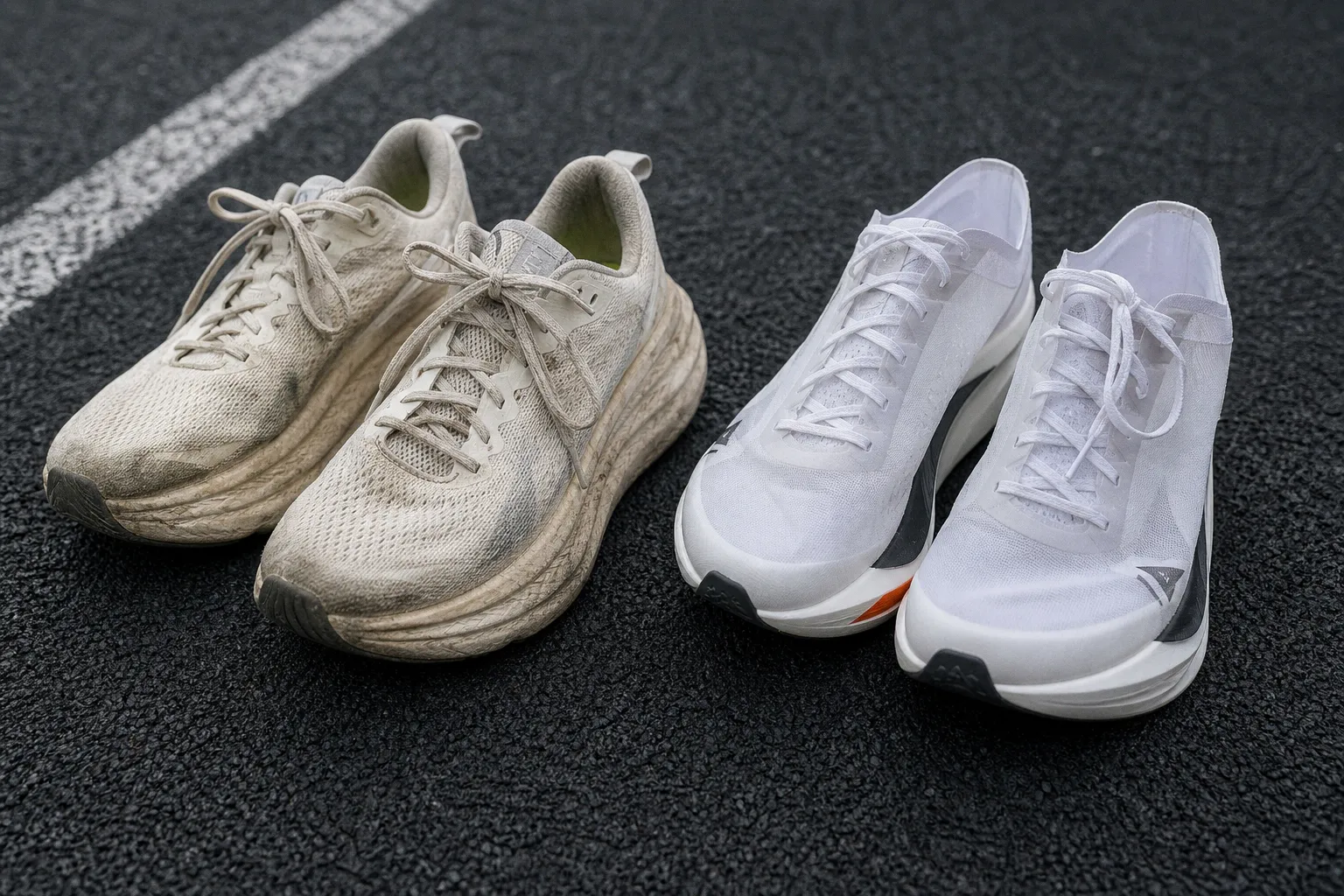
For easy running, the comparison between max cushion vs carbon plated shoes is not really about which feels more premium underfoot. It is about what the shoe asks your body to do when the session is supposed to ask very little. A recovery run is not a secret workout. It is low-intensity aerobic work, movement practice, and—if you have trained hard enough to need it—an opportunity to restore some baseline freshness before the next demanding session.
A carbon plate can make running feel smoother and more propulsive. That is its job. But a shoe that changes your stride, shifts load from the ankle toward the knee and hip, and encourages a longer step is not automatically the best tool for jogging through Zone 1. Marketing has understandably skipped that footnote.
Recovery footwear should reduce the total cost of an easy run, not make the run feel artificially important.
Carbon plates save energy—but not necessarily where you need it
The case for carbon-plated racing shoes is real. Lab testing has found average energy return around 71.1% in carbon-plated models, compared with 58.5% in non-plated running shoes. The exact benefit for any runner varies with pace, mechanics, shoe geometry, and fitness, but the broad point is not controversial: a stiff plate paired with responsive foam can improve running economy.
That is valuable on race day. It can also be useful in a specific workout where you want to rehearse race mechanics or hold a demanding pace with less lower-leg fatigue.
But recovery running is not a race rehearsal by another name. If your easy pace is genuinely easy, the goal is not to manufacture forward roll or extract every possible fraction of economy. The goal is to accumulate low-stress time on feet.
Recent biomechanical research adds a reason to be cautious. A PM&R study published in May 2026 found that running in carbon-plated shoes increased biomechanical markers associated with certain bone-stress injuries, including navicular stress fractures. The study observed lower cadence, more overstriding, higher peak vertical forces, and increased rearfoot eversion angle and velocity in plated shoes.
That does not mean a carbon shoe gives every runner a stress fracture. It does mean “my feet feel less tired” is not the whole audit. Reduced foot and calf fatigue may coexist with a less useful loading pattern elsewhere.
Carbon-plated shoes reduce mechanical work at the ankle joint and redistribute more demand toward the knee and hip. For a hard session, that trade can be acceptable or even helpful. For an athlete with a touchy Achilles, it may feel like mercy. But the body does not interpret redistributed load as deleted load. It simply sends the bill to another department.
This is where recreational runners regularly get trapped. The plated shoe makes an easy run feel buoyant, so the runner subtly speeds up, reaches farther in front, and finishes believing they have “recovered well” because the lower legs are not trashed. Then the hips, knees, or midfoot begin filing complaints two weeks later. No villainous shoe is required. Just a mismatch between tool and task.
The max-cushion promise has a caveat, too
Maximalist shoes are not innocent pillows floating above the laws of physics. They are often the better option for recovery runs, but not because thick foam erases impact.
A typical max-cushion daily trainer starts around a 30 mm stack height, with many models going higher. World Athletics caps stack height at 40 mm for road-race competition, which tells you something about how far footwear design has moved from the thin, low-profile trainers many runners used a decade ago.
At slower paces, a non-plated max-cushion shoe can be excellent for easy mileage. The foam provides comfort, attenuates some of the harshness of repetitive road running, and tends to allow more natural foot motion than a stiff plated racer. For the runner returning after a hard workout, a long run, or a demanding week of standing at work, that comfort has practical value. If a shoe lets you run gently without fighting your feet, it supports the purpose of the day.
But “more foam” is not a universal solution. Research in highly cushioned shoes has found a paradox: at faster speeds, runners can become stiffer rather than softer. In one study, maximalist shoes increased impact loading by 10.7% and loading rate by 12.3% at 14.5 km/h compared with conventional shoes. Even at 10 km/h, the impact peak increased by 6.4%.
The likely explanation is not mysterious. When the surface beneath you feels soft and tall, your nervous system may stiffen the leg to create a stable platform. Your body is not impressed by the foam’s retail price. It is trying to keep you upright.
That does not make maximalist running shoes bad. It makes them pace-sensitive. A plush daily trainer is usually most useful when you actually run it like a daily trainer: relaxed, controlled, and unhurried. Turn your recovery jog into a threshold-adjacent “progression” because the shoes feel good, and you can defeat the point of the cushioning.
Cushioning changes how force is managed. It does not negotiate force out of existence.
Daily trainers vs plated shoes: the practical comparison
The useful running shoe technology comparison is not “old versus new.” Both categories use modern foams, aggressive rockers, and increasingly sophisticated geometry. The distinction is how strongly the shoe dictates the gait cycle.
| Parameter | Non-plated max-cushion daily trainer | Carbon-plated shoe |
|---|---|---|
| Primary job | Comfortable aerobic mileage and easy running | Racing and pace-specific hard efforts |
| Underfoot feel | Protective, often stable and forgiving at relaxed pace | Propulsive, stiff, and strongly rockered |
| Effect on stride | Usually permits more natural variation | Can encourage longer stride and lower cadence |
| Load distribution | More conventional, depending on model geometry | Reduces ankle work while shifting demand toward knee and hip |
| Best use in a rotation | Recovery runs, easy long-run portions, high-frequency easy mileage | Races, selected quality workouts, occasional race-pace practice |
| Main recovery risk | Running too fast because it feels comfortable; instability in overly tall models | Treating the shoe as a recovery device despite altered mechanics |
| Durability logic | Usually built for repeated training mileage | Often costly and less sensible to burn through on slow jogging |
I would add one qualification. “Max cushion” is not a single category with identical behavior. One shoe may be broad-based, stable, and gently rockered; another may be extremely soft, narrow, and tall enough to feel like you are balancing on a mattress in a moving train. Both may have a large stack height. Only one may work for your stride.
Likewise, not every carbon-plated shoe is an aggressive racer. Some plated trainers are heavier and more stable, designed to tolerate training volume. But if the plate and rocker are still changing your mechanics, the label “trainer” does not magically make it a recovery shoe.
Cadence matters more than shoe theatre
If I had to choose one metric to watch during recovery running, it would not be vertical oscillation, ground contact time, or whatever your watch has decided to display in neon this week. It would be whether your stride remains relaxed and compact.
The research finding that plated shoes may lower cadence deserves attention because cadence is not merely a number to optimize. A modestly quicker, shorter step often reduces the tendency to land far ahead of the body. Overstriding can increase braking forces and peak vertical loading. On a fresh runner at race pace, a plate may alter that equation in a tolerable or advantageous way. On a tired amateur jogging slowly, the same geometry may encourage a stride pattern that does not match the session’s purpose.
You do not need to chase a universal cadence target. There is no sacred number that turns every runner into a metronome. Height, pace, terrain, history, and individual mechanics matter. But you should notice whether your recovery shoe lets you keep a quiet, low-drama stride.
A few useful signals:
- Your feet land close to underneath you. You are not reaching for the road because the shoe’s rocker is pulling you forward.
- Your effort remains conversational without restraint. If the shoe makes you itch to accelerate, it may be better reserved for workouts.
- Your calves, arches, knees, and hips feel predictable the following morning. “Predictable” is the underrated word here. Recovery training should not create mysterious new soreness.
- The shoe feels stable when fatigue shows up. A shoe can feel wonderful for the first 20 minutes and become wobbly once your hip control deteriorates. Test it at the end of an easy run, not in a shop aisle.
- You can vary your foot strike naturally. Recovery days do not require one perfect gait pattern. They benefit from not being locked into one rigid solution.
Becker and Borgia’s 2020 work found that maximalist shoes increased activation in the gluteus medius and peroneus longus and produced less ankle dorsiflexion at foot strike. That is not an automatic warning label. It is simply another reminder that footwear is an intervention. It changes muscle behavior. You do not need to fear that fact; you need to stop pretending a shoe is passive.
The recovery-run test is embarrassingly simple
Most runners do not need a laboratory protocol to choose between a max-cushion trainer and a plated shoe for easy days. They need to be honest about the session.
Use a non-plated, cushioned daily trainer for most Zone 1 runs if the run is intended to:
1. Restore movement after a hard interval session or race. Your legs are already carrying fatigue. Adding a stiff lever and altered joint demands is usually needless complication.
2. Build easy weekly volume. Repetition rewards boring reliability. A durable daily trainer is the sensible place to put the bulk of your mileage.
3. Protect a currently sensitive foot, calf, or Achilles without trying to outrun the issue. Cushioning may improve comfort, but pain that changes your gait is not a shoe-selection puzzle. It is a reason to reduce load and assess the problem.
4. Keep effort below the point where form becomes performative. If you are checking splits every few minutes, calling it recovery does not make it recovery.
5. Run on tired legs where stability matters more than pep. A broad platform and predictable foam are usually more valuable than a dramatic toe-off.
A carbon-plated shoe can make sense when you are doing a controlled race-pace segment, a key workout, or a race. Some runners also tolerate short, occasional easy warm-ups or cool-downs in plated shoes around a workout without trouble. But that is different from making them the default for recovery mileage.
The distinction matters because adaptation follows exposure. If every run happens in a plated shoe, you may become accustomed to the shoe’s assistance while accumulating the same altered loading pattern day after day. Long-term evidence on exclusive training in maximalist shoes or plated shoes is not yet settled enough to offer a clean threshold—no honest person can tell you the precise weekly mileage at which one category becomes mandatory or harmful. That uncertainty is a reason for rotation, not panic.
Build a shoe rotation around function, not fantasy
A two-shoe rotation is enough for most amateur runners:
- One non-plated daily trainer with moderate-to-high cushioning for easy runs, recovery days, and general mileage.
- One faster shoe—which may be a carbon-plated racer or a lighter uptempo trainer—for races and the specific workouts that justify it.
If you run high mileage, race frequently, or have very different terrain demands, a third option can be useful: a stable moderate-cushion trainer for days when a very soft, tall shoe feels vague. But this is not an argument to collect footwear like trading cards. The industry has already done enough to persuade runners that every mood requires a different midsole compound.
The baseline question is plain: does each shoe have a job that your training actually requires?
For max-cushion shoes, prioritize fit, lateral stability, outsole grip, and a ride that stays controlled when you are tired. For plated shoes, prioritize fit first and speed second. A plate that rubs your arch, squeezes the forefoot, or pushes you into an awkward stride is not high performance. It is expensive friction.
And do not confuse energy return with recovery. A shoe can return energy to the runner while still changing where the body absorbs stress. Your body is not a single battery with a percentage indicator. It is a system of tissues with different recovery timelines: feet, bone, calf, tendon, knee, hip. The shoe that makes one area feel fresher may be transferring work to another.
That is why I am skeptical when runners announce that carbon plates “save their legs.” They may save a particular sensation in the lower leg. They do not create free training. Nothing does, despite several decades of footwear marketing trying its best.
The blunt answer
For the usual recovery run, choose the non-plated max-cushion daily trainer that feels stable, fits cleanly, and lets you jog without changing your stride to please the shoe.
Save carbon plates for the sessions where their advantages are relevant: racing, race-specific work, and selected faster training. They are not evil, fragile, or forbidden. They are simply specialized equipment, and specialized equipment used for everything becomes a very efficient way to miss the point.
Recovery needs sufficiency: enough easy movement, enough carbohydrate to support the work, enough protein across the day, enough sleep, and a shoe that does not turn a low-cost run into a biomechanical experiment. The rest is mostly marketing.
FAQ
Are carbon-plated shoes better for recovery because they reduce fatigue?
Why should I avoid wearing carbon-plated shoes for easy runs?
Are max-cushion shoes always the best choice for recovery?
How can I tell if my recovery shoes are the right choice?
What is the recommended shoe rotation for an amateur runner?
By Nelson Gould