Foam rolling trigger points: static hold or active roll?
The standard foam-roller routine at most gyms is easy to recognize: somebody finds a sore patch in the quad or upper back and spends two minutes sawing back and forth over it as if persistence might eventually sand the problem away. It looks industrious.
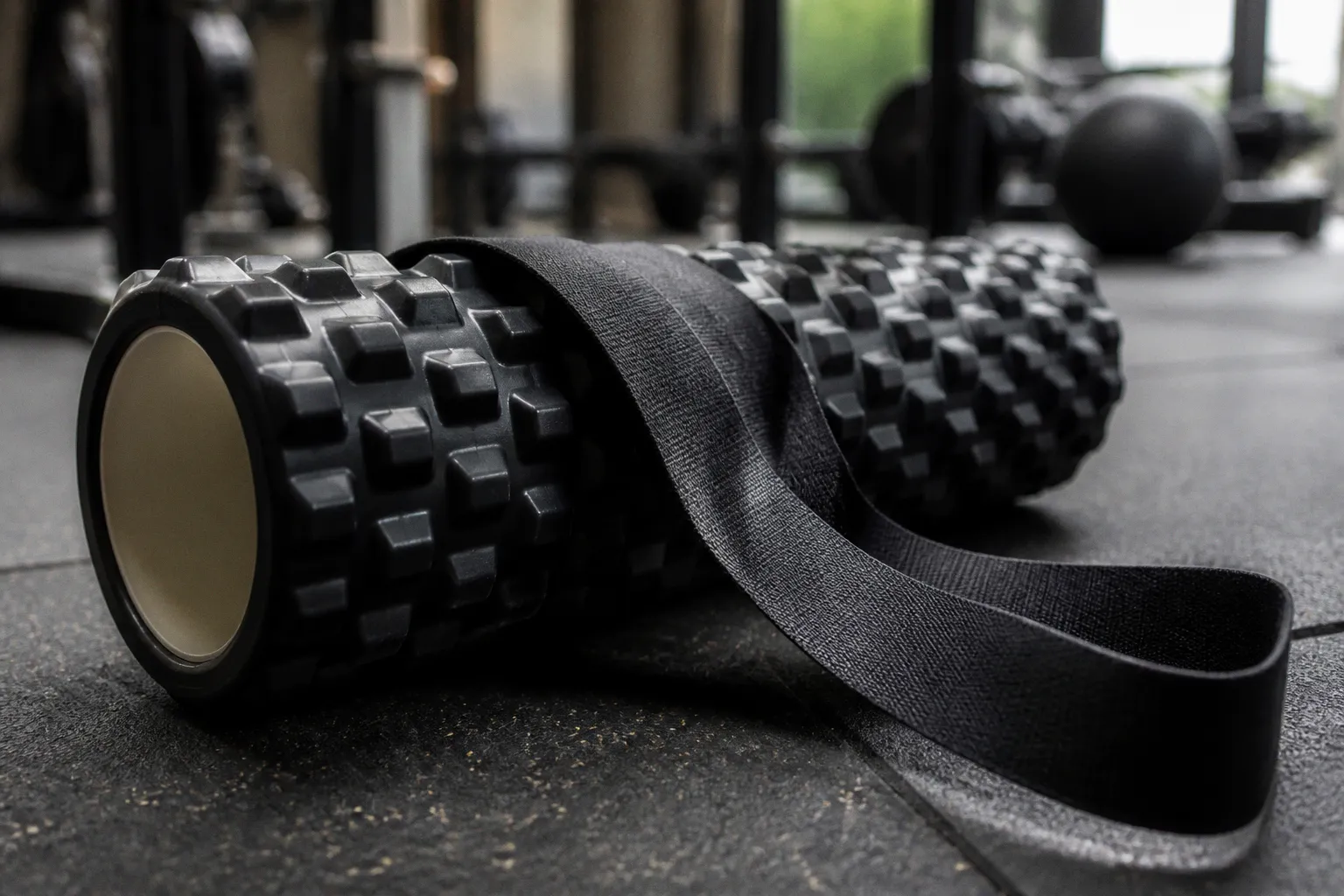
It is also often the wrong tool motion for the stated goal.
If you are using a foam rolling trigger point technique to reduce the sensitivity of one very specific tender spot, static pressure has the better case. A controlled trial found that a 90-second static hold increased pain-pressure tolerance at latent trigger points, while dynamic rolling did not produce a significant change. That does not make rolling useless. It means the roller has two jobs, and amateur athletes routinely use one motion for both because “keep moving” is more marketable than “pause and wait.”
The baseline distinction is simple: hold pressure when you want to work on a localized sensitive point; roll when you want a broader warm-up or a temporary improvement in range of motion. The foam roller is not a fascia demolition device. It is a blunt, cheap way to apply pressure and move through tolerable ranges. No mythology required.
Static pressure versus rolling: what are you actually trying to change?
“Trigger point” is a useful practical term, but it has collected a remarkable amount of marketing baggage. In the gym, it often means any place that hurts when pressed. In practice, a latent myofascial trigger point is a sensitive area that may not hurt at rest but feels distinctly unpleasant under pressure and can limit comfortable movement.
That is different from general post-training soreness. It is also different from a tendon problem, a strained muscle, nerve irritation, or pain referred from the spine. A roller cannot diagnose these distinctions, and neither can the confidence of the person holding it.
For a self-administered foam roller trigger point release, the working principle is modest: apply tolerable, sustained pressure to a localized tender area, then reassess how it feels and moves. The exact mechanism remains unsettled. It may involve changes in pain modulation, muscle tone, circulation, or some combination. I would resist anyone claiming to have settled that debate while selling a textured roller with “deep-release nodes.”
What we can say is more useful. In the 2018 randomized trial by Wilke and colleagues, a 90-second static hold on a latent trigger point increased the pain-pressure threshold from 2.6 ± 0.8 to 3.0 ± 1.1. Dynamic rolling and a placebo intervention did not significantly change sensitivity. In plain English: a sustained hold made that point less tender in the short term; rolling back and forth did not show the same result.
| Goal | Static hold | Dynamic rolling |
|---|---|---|
| Reducing sensitivity at one localized tender point | Better-supported option | Less convincing for this specific outcome |
| General preparation before training | Useful, but targeted | Useful across a broader area |
| Short-term range of motion | Can help as part of a sequence | Often useful |
| Sensation | Intense, localized pressure | Diffuse, repetitive pressure |
| Best use | “This exact spot is tender” | “This region feels generally stiff” |
| Common mistake | Holding breath and forcing excessive pain | Rolling randomly without ever pausing |
A tender spot is not a command to attack it faster. It is usually a cue to slow down.
The “static pressure vs rolling myofascial release” argument gets distorted because people expect one winner to erase the other. That is not the physiology, and it is not the practical answer. Dynamic rolling has value for broad exposure to pressure and for short-term movement preparation. It just is not the strongest choice when your actual objective is to reduce the sensitivity of a specific point.
Why the pause beats the scramble for pain sensitivity
When you roll quickly over a sore patch, the pressure arrives and leaves before your body has much time to respond to it. You feel a lot, certainly. Feeling a lot is not the same as getting a better outcome.
Static compression gives you a chance to settle on the point, control the load with your body weight, and wait for the discomfort to change. The National Academy of Sports Medicine advises locating the most tender point and holding it for roughly 30 to 90 seconds, ideally until the sensation decreases. Other clinical education guidance starts more conservatively—10 to 20 seconds—and treats one to two minutes as a ceiling rather than an endurance challenge.
That range matters. Not because 89 seconds is science and 91 seconds is chaos, but because trigger-point work should be measured rather than theatrical.
A good static hold usually follows this pattern:
1. Find the point, not the whole neighborhood. Roll slowly across the muscle until you find a localized area that is clearly more sensitive than the tissue around it. If everything hurts equally, you may be dealing with general soreness rather than a discrete point worth targeting.
2. Use enough pressure to notice it, not enough to brace against it. Aim for discomfort you can breathe through without clenching your jaw, holding your breath, or grimacing for social media. If you cannot relax into the position, reduce load by shifting more weight into your hands, feet, or opposite leg.
3. Hold for 30 to 90 seconds. Start shorter if you are new to this. The useful signal is often a reduction in discomfort, a softening of the protective tension around the area, or simply the ability to breathe normally in the same position.
4. Reassess movement rather than assuming success. Stand up, squat, hinge, reach, or rotate—whatever movement brought the area to your attention. If it feels easier, you have a practical result. If nothing changes after a few attempts across several sessions, more rolling is not a strategy. It is repetition.
5. Move afterward. Take the newly tolerable range into an active movement: a bodyweight squat after the glutes, a lunge after the hip flexors, a controlled overhead reach after the lats. The roller may create a brief window; your job is to use it.
The important word is brief. Foam rolling is not a permanent structural remodel. It does not “break up adhesions” in the dramatic sense often implied by fitness marketing. Human fascia is not softened like candle wax by a few passes over a dense cylinder. The forces required to permanently deform it are far beyond what you can reasonably produce with a roller and your body weight.
That does not make the intervention fake. It makes the popular explanation inflated. Those are different things.
A practical protocol for trigger point foam roller techniques
I use a simple sequence with athletes who are tempted to turn recovery into an evening-long wrestling match with a roller. It is intentionally boring. Boring protocols are easier to repeat and less likely to become self-inflicted bruising.
Step one: scan, do not grind
Spend 20 to 30 seconds slowly exploring the target muscle. For the lateral hip, that might mean the upper gluteal area rather than directly rolling your entire side. For the upper back, it means working around the muscles beside the spine rather than pressing hard into the spine itself.
Look for a point that is:
- distinctly more tender than the surrounding tissue;
- located in muscle rather than on a bony prominence or tendon;
- relevant to how you feel when moving;
- tolerable under moderate pressure.
A sore point that shoots pain, tingles, causes numbness, or sends symptoms down an arm or leg is not an invitation to push harder. That is a reason to stop and get a proper assessment if it persists.
Step two: use a static hold first
Settle your weight onto the tender area for 30 seconds. If the sensation remains tolerable and begins to ease, extend toward 60 or 90 seconds. For many athletes, that is enough.
The Cooper Aerobics-style sequence adds a useful follow-up: after a one-minute static hold, make a few controlled passes along the muscle and then across it—four in each direction is a reasonable practical dose—before finishing with a pin-and-stretch movement. “Pin-and-stretch” means keeping gentle pressure near the point while actively moving the adjacent joint through a comfortable range.
For example, if you are on a tender area of the upper glute, you might hold pressure with the roller, then slowly rotate the hip or bend and straighten the knee. The point is not to invent contortions. The point is to let the muscle experience movement after pressure.
Step three: test the task that matters
If your hip felt restricted in a squat, do five controlled squats. If your upper back felt stiff during overhead work, try a few unloaded reaches. If your calf felt guarded during running, walk briskly and perform a few calf raises.
The result you care about is not whether the roller session hurt productively. It is whether the relevant movement now feels more comfortable or more available.
The roller is a bridge to movement, not the destination of recovery.
Step four: stop before the returns disappear
One or two areas, one or two holds each, then movement. That is usually plenty. The athlete who spends 25 minutes chasing every tender square inch of both legs is often compensating for a worse baseline: rushed training progressions, insufficient sleep, too little carbohydrate around hard sessions, or a week that contains no easy days despite claiming otherwise.
I am a dietitian, so I will say the unfashionable part clearly: no recovery tool compensates for chronic under-fueling. If your training load rises while energy intake stays stuck at “trying to be good,” your legs may remain sore because they are under-recovered, not because they need a more aggressive roller pattern. Foam rolling is not nutrition, sleep, or load management. It is a small intervention. Keep it in its lane.
Where active rolling still earns its place
Dynamic rolling is not the loser in this comparison. It simply answers a different question.
Use it when the issue is broad stiffness, when you want a gradual sensory warm-up before training, or when you are trying to access a little more range before a session. Slow, controlled passes over the calves, quads, glutes, thoracic region, or lats can make movement feel less restricted. For some athletes, that alone is enough reason to use it.
The practical mistake is treating every inch of a muscle as a trigger point. If your quads feel generally heavy after a long ride, a minute of easy rolling from knee toward hip may be sensible. If there is one thumb-sized spot in the lateral quad that is dramatically more tender, pause there first.
This is how I would divide the two approaches around training:
| Timing | Static holds | Dynamic rolling |
|---|---|---|
| Before a hard session | Brief, only if a specific point limits movement | Useful for a short general prep sequence |
| After training | Appropriate if a localized spot is unusually sensitive | Fine for a few easy passes if it feels good |
| On an active recovery day | Targeted and restrained | Useful alongside easy walking, cycling, or mobility work |
| During acute injury or unexplained pain | Not a DIY fix | Not a DIY fix |
The phrase “tissue hydration” often appears in rolling advice. I would treat it as shorthand, not as a magical explanation. Rolling can change how the area feels and moves in the short term. That is enough. You do not need to imagine a dry sponge becoming restored by six passes in each direction.
A better test is brutally simple: does five minutes of rolling help you move better for the activity you are about to do? If yes, keep it. If it only gives you an impressive collection of painful noises and no change in training, remove it from the routine.
The anatomical no-go zones people ignore
A foam roller is wide, awkward, and indiscriminate. This is exactly why it should not be applied indiscriminately.
Do not place direct pressure on joints, bones, the neck, the armpits, or tendons. Avoid pressing into the front or side of the neck, the low back itself, the knee joint, the front of the hip, and the bony ridge along the shin. These areas are not “tight muscles hiding from the work.” They contain structures that do not benefit from being compressed by a hard cylinder.
Be cautious around the lateral thigh as well. Many people grind directly along the iliotibial band because it is famously unpleasant. Pain is a poor compass here. The IT band is dense connective tissue, not a muscle you can meaningfully lengthen with a roller. If the outside of the thigh feels troublesome, shift attention to the gluteal muscles and lateral quadriceps, then assess hip control and training load.
Stop the session if pressure causes:
- sharp or escalating pain rather than tolerable discomfort;
- tingling, numbness, burning, or electric sensations;
- bruising that keeps appearing after ordinary pressure;
- symptoms that worsen over the following day;
- pain near a recent injury, surgery, fracture, or suspected tendon problem.
And if a “trigger point” keeps returning in the same place, do not make the roller your full-time therapist. Recurrent calf tenderness may be connected to abrupt running-volume changes. Persistent upper-back tension may reflect desk posture, breathing habits, shoulder strength, or simply too much pressing and too little pulling. A tight-feeling hip can be a load-management issue rather than a mobility failure. The roller can calm a symptom. It does not automatically explain it.
The less glamorous answer
For foam rolling trigger points, use static pressure first: locate the tender spot, hold 30 to 90 seconds at a tolerable intensity, then move and reassess. That approach has better support for reducing point sensitivity than mindless back-and-forth rolling.
Use active rolling for general stiffness, preparation, and short-term range of motion. Keep it slow, brief, and purposeful. Do not claim you are crushing fascia into submission; the body has survived without that story.
Your recovery baseline remains sleep, adequate food, sensible training progression, and enough genuinely easy work between hard sessions. The roller is useful precisely because it is small. Use it like a small tool.
FAQ
Should I roll back and forth over a sore spot?
How long should I hold pressure on a trigger point?
What should I do after foam rolling a tender area?
Are there areas I should avoid foam rolling?
Can foam rolling break up fascia or adhesions?
By Nelson Gould