Build strength anywhere with smart home workouts
A cluster of recent coverage centers on home strength training, with Gulf News publishing a roundup of adjustable dumbbells and accessories for readers building a home setup.
Duncan Reed·updated July 12, 2026
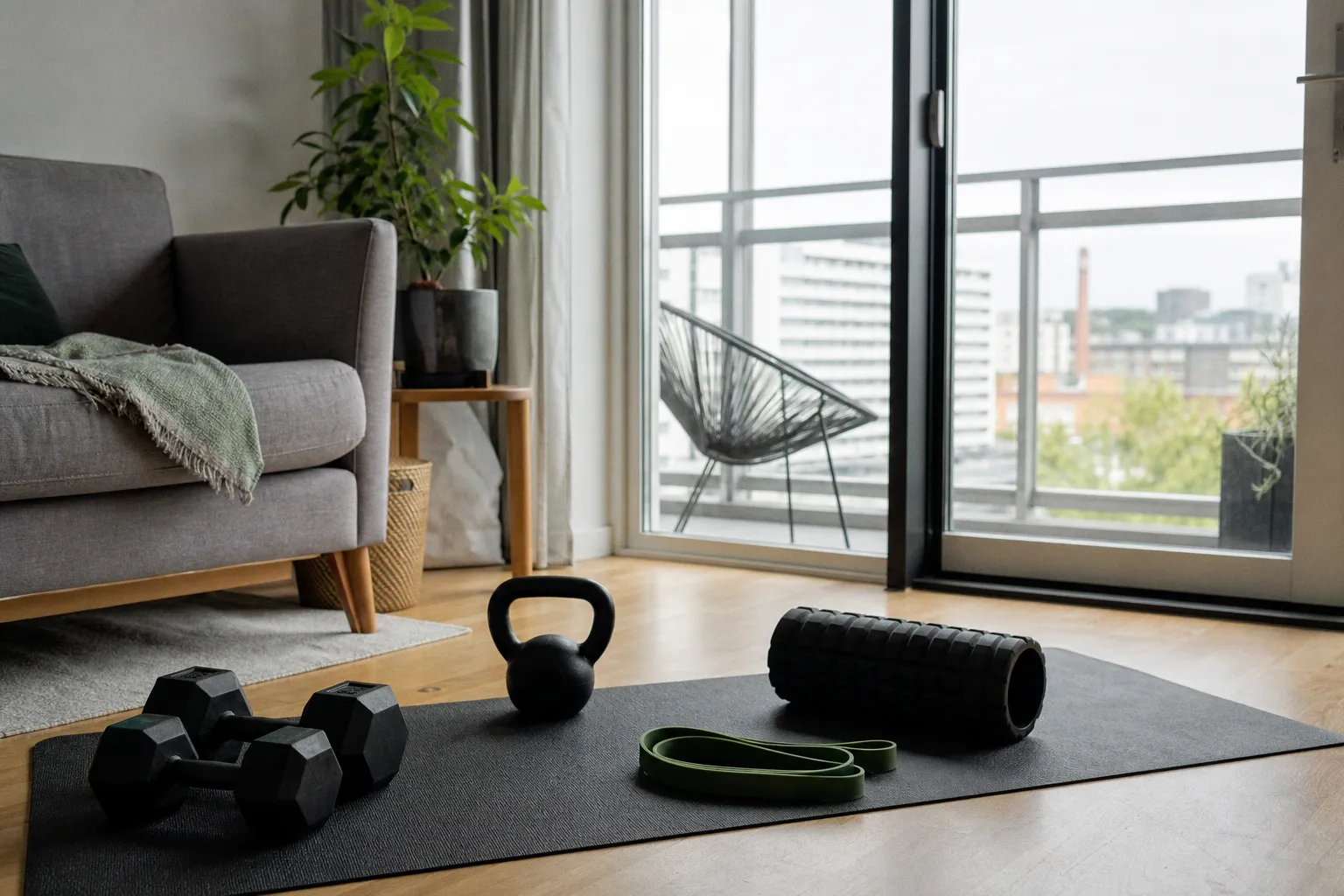
Equipment as a load-management decision
Adjustable dumbbells solve a specific mechanical problem. A full rack occupies floor space, creates long transition times between loads, and forces the lifter to plan sets around available weight pairs. A selector system collapses that overhead into a single dial or pin. Less downtime between exercises means more work per unit time — a direct input to training density.
The Gulf News roundup evaluated equipment on five criteria: adjustment speed, usable weight range, build quality, footprint, and value. That list maps onto the variables that actually govern training outcomes. Adjustment speed affects session density. Weight range determines whether progressive overload is possible across a cycle. Build quality caps the safe load. Footprint dictates whether the equipment survives six months of consistent use.
The roundup named the BowFlex SelectTech 840 as the best overall option, citing a wide weight range and a dial system that reviewers from Coach and Tom's Guide described as smooth. Lower increments increase in small steps — relevant for isolation work where progressive overload depends on fine load adjustments. The heavier end supports compound lifts, though the bulkier profile suits controlled strength work better than dropped-weights training.
PowerBlock took a different mechanical route: a magnetic selector pin instead of a rotating dial, with changes between exercises becoming near-instantaneous. The square plate shape keeps the footprint compact but alters grip geometry — a variable worth testing before committing to heavy pressing.
For newcomers, the roundup pointed to Domyos hand grips as a low-cost entry and a PROIRON resistance band kit as a complement. Bands cover movements dumbbells handle poorly: rows, assisted pull variations, mobility drills, warm-ups. They also fit supervised rehabilitation contexts.
The movement question
AOL published a piece headlined "The Trap Bar Deadlift May Be the Most Functional Way to Build Lower-Body Strength." The headline positions the trap bar as a primary lower-body builder; source text was not available, so the argument sits in the title alone. Even so, the framing has practical implications for any home setup.
The trap bar keeps load near the body's midline rather than in front, altering the kinematic demand on the lumbar spine and shifting recruitment toward the quadriceps. The format also reduces the floor clearance required for a bar path and accommodates hip-width stance pulling — patterns a straight barbell cannot replicate in tight spaces.
The minimum viable setup
For an athlete building a home strength setup from scratch: one adjustable dumbbell pair with a usable range wide enough to span a full training cycle. One compact resistance band kit. One floor space roughly two meters square. Compound movement patterns only — hinge, squat, press, pull. Adjust loads in small increments. Track session density, not perceived effort. The equipment is a tool. The variables that drive adaptation are load, volume, frequency, and progression. Everything else is storage.