Massage guns or compression boots: the best recovery approach
The claim that one recovery device “flushes toxins” while the other “breaks up knots” has done exceptionally well for marketing departments and rather less well for human physiology.
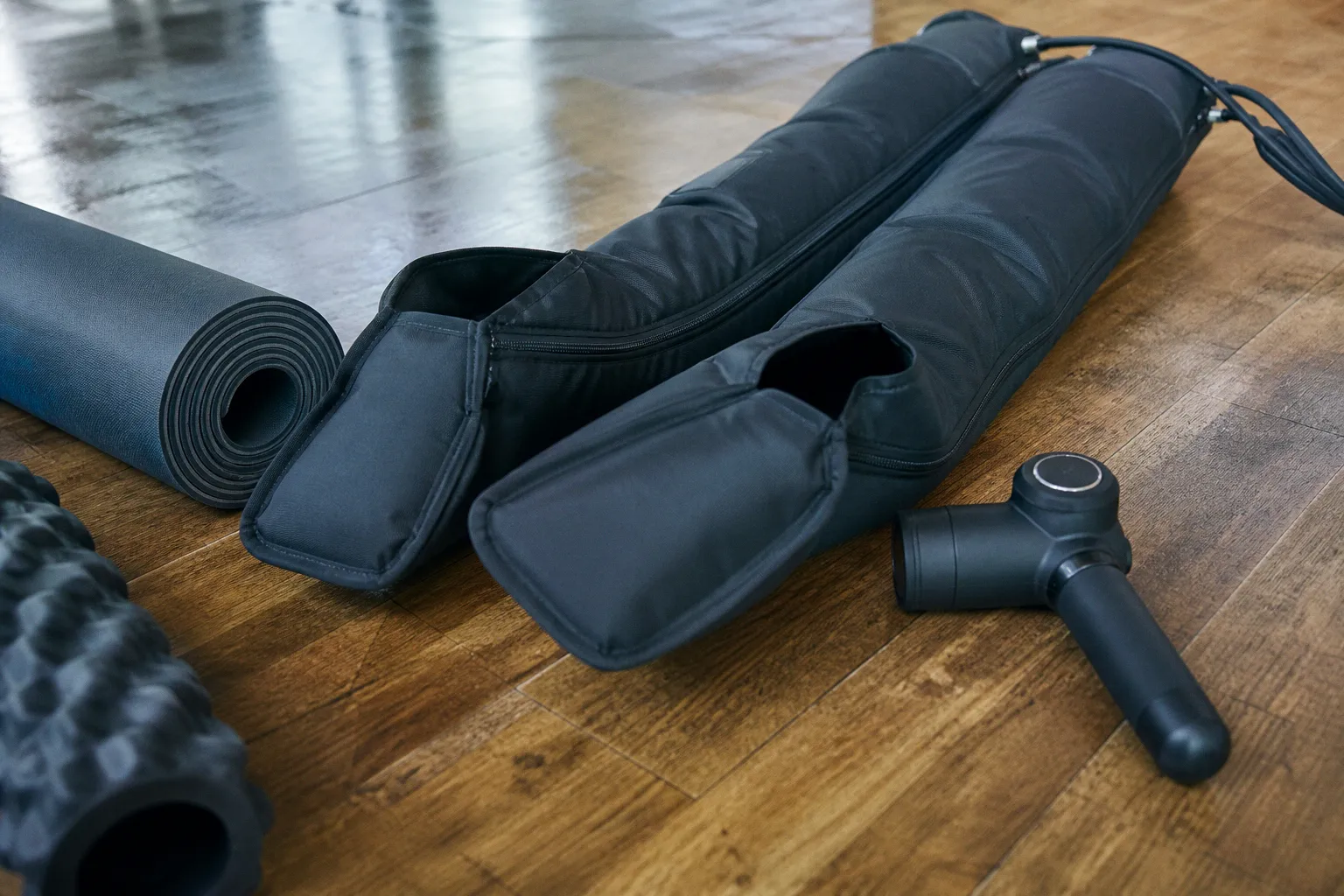
Athletes are left comparing a percussion device that resembles a power tool with inflatable leg sleeves that resemble an economy-class space suit, then asking which one will make tomorrow’s session feel easy.
Neither will do that reliably. A massage gun and compression boots can change how you feel after training, and that can be useful. But neither device repairs training damage on command, prevents injury, or earns you the recovery that poor sleep, low energy intake, and a chaotic training week have already spent.
For the amateur athlete deciding on massage gun vs compression boots for athletes, the useful distinction is not “which is more advanced?” It is much plainer: do you need short-term local mobility work, or do you want a passive, reasonably pleasant way to reduce the sensation of tired legs? Those are different jobs. The devices are not interchangeable simply because both appear in recovery reels beside expensive flooring and suspiciously blue lighting.
Recovery tech can improve a recovery routine. It cannot replace the baseline: enough food, sleep, sensible load progression, and time.
The evidence gap: percussion versus pneumatic compression
The first inconvenient fact is that there is no convincing direct randomized trial showing whether a handheld massage gun beats lower-limb compression boots, or vice versa, for athletic recovery. That matters because product comparisons often borrow evidence from adjacent interventions as though all pressure is the same pressure.
It is not.
Manual massage is not a massage gun. Static compression tights are not intermittent pneumatic compression. A therapist’s hands are not six air chambers inflating around your calves. These distinctions are tedious only until someone uses them to sell you a conclusion the research has not reached.
The current evidence suggests a fairly sensible division:
| Question | Massage gun | Compression boots |
|---|---|---|
| Most plausible short-term use | Improving local range of motion and flexibility | Reducing the feeling of heavy or sore legs |
| Best fit in a training week | Before training or after a localized tightness issue | After long runs, rides, tournaments, or leg-heavy training |
| What it does not reliably improve | Strength, balance, sprinting, agility, explosive output | Next-day functional performance in every context |
| Typical practical dose in research | Highly variable; no universal setting or attachment | Often 20–30 minutes around 80 mmHg in studies |
| Main mistake | Hammering sore tissue too aggressively | Treating a medical red flag as a recovery problem |
| What the evidence cannot tell you | The ideal speed, amplitude, pressure, or duration for everyone | That boots are universally superior, or that more pressure is better |
This is not a thrilling conclusion, but it is a usable one. A device can have a narrow benefit without being useless. The trouble begins when a narrow benefit is inflated into a whole-body recovery strategy.
For most recreational athletes, the baseline question is whether the device solves a real constraint. If your ankles feel restricted before squatting or running, localized percussion may have a role. If you have just finished a long cycling event and your legs feel generally battered but you are not looking for a pre-workout mobility change, boots may be more appealing. If you are chronically sore because you increased mileage by 40 percent while under-eating, the correct recovery tool is neither of these. It is a calendar and a plate.
What a massage gun can actually do
Massage guns deliver repeated mechanical pulses to a local area. The language around this category tends to become theatrical very quickly: fascia “release,” deep “knot destruction,” lactate “clearing.” I would retire most of it.
The better case for percussion therapy is modest and specific. A 2023 systematic review found that massage guns may improve short-term range of motion, flexibility, and some recovery-related outcomes. It did not support their use for improving strength, balance, acceleration, agility, or explosive performance. That is a very different promise from “unlock your athletic potential,” though naturally less useful for a product box.
The quality of the evidence deserves some skepticism. The review screened 281 records but included only 11 studies. Ten of those studies had a moderate risk of bias, and one was rated high risk. That does not mean every result is wrong. It means we should not use an eleven-study evidence base as permission to invent a grand theory of recovery.
Mobility is the strongest case, not brute force
If I were using a massage gun in a practical training setting, I would think of it as a temporary mobility input rather than a tissue-repair machine.
A short, tolerable application to the calf before a session may help someone access ankle motion more comfortably. The same logic can apply to the quadriceps, glutes, or upper back before lifting, provided the athlete has a clear reason for doing it. The goal is not to make the muscle hurt so much that it must be “working.” Pain is not a calibration system.
A useful, restrained approach looks like this:
1. Start with the movement you want to improve. Check a bodyweight squat, ankle dorsiflexion, hip rotation, or shoulder position first. If there is no meaningful limitation, there may be nothing to fix.
2. Use a short application on the relevant area. The research does not establish a universally superior speed, amplitude, attachment, or duration. Start conservatively rather than treating maximum power as a personality trait.
3. Re-test the movement. If your squat, stride, or warm-up movement feels easier, proceed into active preparation: drills, easy sets, or sport-specific work.
4. Stop if it creates guarding or extra soreness. A massage gun should not turn a manageable stiff calf into a tender calf that alters your gait.
5. Do not use temporary freedom of movement as permission to ignore pain. Better range of motion is not the same as a resolved tendon, joint, or muscle problem.
One within-participant study makes this point neatly. Active adults used a massage gun for five minutes on one calf immediately after strenuous exercise, with the other calf untreated. The study found no meaningful group-by-time differences in ankle range of motion, calf size, isometric strength, calf endurance, or soreness. There were even small immediate and four-hour increases in soreness after use.
That is not a verdict against every massage gun session. It is a warning against the standard amateur habit: applying more force for longer because the device makes a satisfying noise. The body is not persuaded by sound effects.
The common massage gun mistakes
Most massage gun mistakes to avoid come from confusing discomfort with effectiveness.
- Using it over acute pain, bruising, or a suspected tear. A painful hamstring strain does not need percussion. It needs assessment, appropriate load management, and a plan.
- Pressing hard enough to create numbness or sharp pain. More mechanical input is not automatically better input. If you have to brace against the device, you have already lost the plot.
- Using it instead of warming up. Temporary passive mobility should lead into active movement. It is not a substitute for raising body temperature and rehearsing the session.
- Chasing a “release” before every workout. If you need aggressive work on the same spot daily just to train, the issue is probably training load, technique, footwear, or an unresolved injury—not a shortage of percussion.
- Applying it around bony areas, irritated nerves, or visibly inflamed tissue. The goal is not to see what the device can tolerate. The goal is to remain able to train next week.
Massage guns are portable, quick, and targeted. That is their real advantage. A runner can use one briefly in a warm-up routine; a lifter can address a perceived restriction between desk work and training; a cyclist can use it on calves or quads without devoting half an evening to recovery theater.
But they are poor tools for a vague, whole-leg feeling of fatigue. Trying to “massage gun” both legs after a three-hour ride is possible. So is peeling a potato with a credit card. Neither is the efficient choice.
Compression boots: passive relief, not a performance guarantee
Compression boots use intermittent pneumatic compression: chambers around the feet and legs inflate and deflate in sequences. The subjective experience is pleasant for many people. That counts for something. A recovery practice you will actually use, without turning it into an ordeal, can help create a calmer post-training routine.
But the physiological claims need editing.
A 2024 systematic review and meta-analysis of lower-limb intermittent pneumatic compression included 17 studies with 319 participants. It found trivial-to-small benefits for muscular function, trivial-to-moderate effects on pain and soreness, and highly variable effects on markers associated with muscle damage.
Translated into normal language: boots may help some athletes feel less sore or less fatigued, but the effects are not large, not perfectly consistent, and not proof that your muscles have been restored to factory settings.
The term “flushes lactate” should be handled carefully. Lactate is not a villainous residue sitting in your calves awaiting evacuation. After exercise, lactate levels typically fall quickly through normal metabolism. A boot session can feel restorative without being a magic drainage procedure. Marketing prefers the drainage story because it gives the air pumps a heroic role. Physiology is less cinematic.
What the common protocols tell us—and what they do not
Across the intermittent pneumatic compression research, a common pattern was roughly 20 to 30 minutes at around 80 mmHg. That is a description of frequently used research protocols, not an official standard and certainly not a personal prescription.
Some research has used different settings. One trial compared 30 minutes of lower-leg pneumatic compression at 110 mmHg against static compression garments in the 20–30 mmHg range. The fact that numbers differ across studies is exactly why users should resist the instinct to set every device to maximum. There is no evidence here that the highest setting is the best setting across sports, body sizes, or training loads.
A randomized ultramarathon study is also instructive. After a 161-kilometer race, a single 20-minute session of intermittent sequential pneumatic compression reduced subjective muscular-fatigue ratings immediately compared with supine rest. But it did not improve 400-meter running time or show significant functional or subjective advantages from one to seven days later.
That is the sort of result I find useful because it refuses to oversell itself. Boots may improve the immediate feeling of post-race fatigue. They did not produce a reliable performance miracle over the following week.
Compression boots are best understood as a comfort intervention with possible soreness benefits, not as an invoice you submit to biology for instant adaptation.
For athletes with dense schedules, that comfort can still matter. A tournament player who has another match tomorrow may value 25 quiet minutes with legs elevated and boots running. A cyclist after a stage event may appreciate a structured cue to stop standing in the kitchen and start recovering. If the ritual helps you transition from training to eating, rehydrating, and sleeping, it has practical value beyond the pressure cycle itself.
Just do not confuse the ritual with the mechanism. The boots did not create recovery from nothing. They may have made the recovery period feel better organized.
Which tool matches your actual training problem?
The right choice depends less on your sport than on the pattern of fatigue you are trying to address. “My legs are cooked” is not a diagnosis, but it is at least more honest than “I need to optimize recovery.”
Choose a massage gun when the problem is local and movement-specific
A massage gun generally makes more sense if:
- You have a particular area that feels stiff before training, such as the calves before running or the upper back before overhead work.
- You want a short pre-session intervention followed by active mobility and warm-up drills.
- You travel often and need a compact device rather than another large item competing for floor space.
- You respond well to local self-massage but do not need an extended recovery ritual.
- You can identify a movement outcome: “my ankle motion is restricted,” not merely “I own a device and would like to use it.”
For a runner, this might mean one brief calf application before ankle mobility drills and easy strides. For a lifter, it might mean a short pass over the quads or lats before movement preparation. The device is a bridge into training, not the main event.
Choose compression boots when fatigue is diffuse and you want passive downtime
Compression boots for leg recovery are a more logical fit if:
- Your legs feel generally heavy after a long run, ride, hike, tournament, or lower-body session.
- You have enough time to sit or lie down for 20 to 30 minutes without turning it into an excuse to skip dinner.
- You find the sensation genuinely relaxing and it helps you finish the day in a calmer state.
- You have repeated high-leg-volume weekends—endurance events, multi-day cycling, field sports, ski training—and want a non-impact recovery ritual.
- You already have the basics of recovery reasonably under control.
That last point is the one people dislike. Compression boots are expensive enough that buyers want them to compensate for a bad baseline. They cannot.
If you trained hard, ate little carbohydrate, took in too little total energy, and slept five hours, your legs are not “failing to recover” because they lacked 80 mmHg of sequential compression. They are responding normally to inadequate inputs. The solution is usually food, fluids, sleep, and a better plan for the next hard week.
The cost question is not glamorous, but it is real
A massage gun usually wins on convenience and cost. It is easier to store, easier to transport, and useful for short local sessions. Compression boots occupy more space, require more time, and make the most sense for athletes who repeatedly accumulate significant lower-body fatigue.
I would not buy boots first for a novice runner doing three short runs per week. I would first spend the effort on progressive training, suitable shoes, sufficient carbohydrate around longer sessions, and sleep consistency. Add recovery gear when it addresses a specific friction point, not because your social feed has decided that sitting still in pneumatic sleeves is what serious athletes do.
The same skepticism applies to connectivity and apps. A device does not become more physiologically effective because it can graph its pressure sequence on your phone. Training data already has a habit of multiplying faster than useful decisions. Before adding another dashboard, ask whether you can name the decision it will change.
This matters as sports media and fitness technology become increasingly fragmented ecosystems; the broader shift toward bundles and competing platforms is visible in the pressure on sports streaming services to consolidate. Recovery tech is moving in a similar commercial direction: hardware, subscriptions, presets, premium tiers, and a steady suggestion that one more connected layer will make training coherent. Usually, coherence still comes from a simple plan you can repeat.
Safety: do not turn a symptom into a gadget problem
There is a category error in much recovery content: treating every ache as ordinary soreness and every ordinary soreness as something that needs a device. Sometimes the correct response is no device and a medical assessment.
Compression systems have particular cautions. One manufacturer’s safety manual warns against use in people with diagnosed blood clots, deep-vein thrombosis, phlebitis, poor circulation, numb areas, swollen or inflamed areas, skin eruptions, or unexplained calf pain. It also advises medical consultation for people who are pregnant or have heart or vascular problems.
Those warnings belong in the conversation because a swollen, painful calf is not a cue to zip yourself into boots and wait for the wellness to happen. It is a reason to seek proper evaluation. The same applies to one-sided swelling, sudden unexplained pain, numbness, unusual skin changes, or persistent symptoms that alter how you walk or run.
Massage guns require common sense too, although their risks are different. Avoid aggressive use over acute injuries, areas of altered sensation, visibly swollen tissue, and sites where pain is sharp, spreading, or unexplained. Do not use percussion to override symptoms and force a training session. Temporary sensory relief can make a poor decision feel more athletic. It remains a poor decision.
Neither category replaces assessment for a suspected injury. Neither is a proven injury-prevention tool. If your Achilles is painful every morning, your knee swells after runs, or your calf keeps tightening on one side, the answer is not a more expensive attachment head or a higher compression setting.
Build recovery around the parts that actually adapt you
Recovery tools are most useful when they occupy their proper place: after the boring essentials and before the nonsense.
My order of operations is uncomplicated:
1. Match training load to your current capacity. The best recovery intervention is often not digging a hole that requires an expensive escape ladder.
2. Eat enough, especially around demanding sessions. Carbohydrate availability, total energy sufficiency, and adequate protein give the body material to recover. A massage gun does not contain calories, despite the price.
3. Sleep consistently. No gadget has produced a credible substitute for sleep. Many have produced better packaging.
4. Address pain and persistent dysfunction early. Do not use temporary comfort to delay the conversation you need to have with a qualified clinician.
5. Then choose the tool that makes the routine easier. Massage gun for local, short-term mobility. Boots for broad lower-leg comfort and a passive recovery window.
The distinction becomes even clearer when you stop asking which device is “best.” Best for what? A massage gun is more practical if you want a five-minute local input before training. Compression boots are more practical if you want a low-effort decompression period after a long day on your feet. Neither deserves to be called essential recovery equipment for every athlete.
If you own a massage gun, use it lightly, locally, and with a movement purpose. If you own compression boots, use them as a pleasant post-training option, not as a medical device or a performance guarantee. If you own neither, you are not behind.
The blunt version is this: buy recovery gear for convenience and comfort, not salvation. Your body still responds most reliably to sufficient fuel, sensible training, and sleep. Everything else is an accessory.
FAQ
Should I use a massage gun before or after my workout?
Do compression boots actually flush out lactate?
Are higher pressure settings on recovery devices more effective?
Can I use a massage gun on a painful or injured muscle?
How long should I use compression boots?
By Nelson Gould