Electrolyte drinks for workout: do you actually need them?
You've been there: midway through a hot ride or a long Saturday run, and a small twitch lands in your calf, your hamstring, your arch. Your brain does what it always does in that moment — it reaches for the brightly colored bottle. Electrolytes.
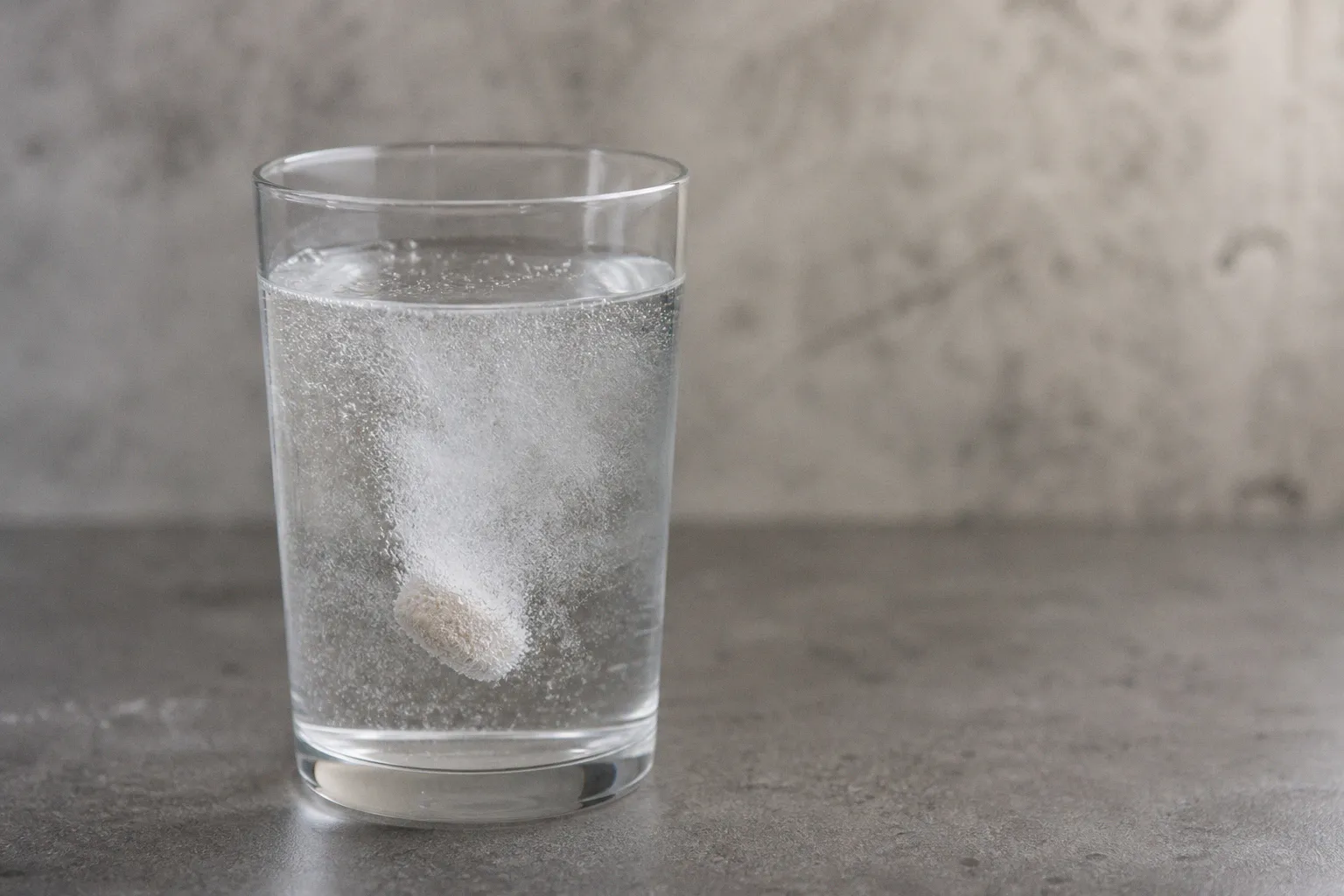
Because everyone tells you electrolytes fix cramps.
Here's the quieter truth. Most recreational athletes don't need an electrolyte drink for most workouts. We reach for the sports drink because the marketing is excellent and because the body sends a confusing signal mid-effort. The actual science of when sodium and carbohydrates become necessary — and when they just sit in your gut as extra sugar — is more straightforward than the beverage aisle suggests.
The 60-Minute Threshold: Why Water Wins for Most Workouts
For exercise that lasts under about sixty minutes, performed at a moderate effort in normal weather, plain water is almost always sufficient. The American College of Sports Medicine has been remarkably consistent on this point: as long as you're eating a reasonably balanced diet and you aren't setting out on a fasted, multi-hour endurance event, your body's pre-loaded tank of electrolytes — built up from yesterday's meals and yesterday's recovery — is enough to cover the minerals you're losing through sweat.
The trouble is that "moderate effort" and "normal weather" are doing a lot of work in that sentence. If you're doing intervals hard enough that your breathing is ragged for forty-five minutes, if the room you're training in is above roughly 24°C (75°F), or if you're wearing extra layers for a sweat-based protocol, you're moving closer to the edge of that 60-minute window much faster than the clock suggests. But for the standard early-morning gym session, the 45-minute dog walk in cool weather, the easy spin class after work — water is the right tool.
It is worth sitting with how unusual that sounds in our current environment. The fitness industry has spent two decades training us to believe that anything more strenuous than a stroll demands a proprietary sports drink. We see neon bottles on every gym counter, in every runner's hand, in every influencer's gym bag. The product is fine. The blanket prescription is not.
The honest math: a typical recreational workout under an hour in temperate conditions costs you less than 500 mg of sodium — easily replenished by your next meal.
Decoding Sweat: Individual Sodium Loss and Performance Impact
The reason electrolytes become genuinely useful is that sweat isn't just water. It's a salt solution, and how salty your particular solution is varies more than most athletes realize. Research has measured sodium concentration in human sweat ranging from roughly 200 mg per liter on the low end to about 2,000 mg per liter on the high end. The average sits closer to 800–950 mg per liter, but "average" doesn't mean you.
If you are a heavy sweater — visible salt crust on your forehead, white streaks on a black cap, eyes that sting — you are losing more sodium per liter than your training partner next to you. If your sweat is barely visible and your skin stays mostly dry even during hard work, you are on the lower end. Both are normal. Both are physiologically valid. Neither tells us everything we need to know without an actual measurement.
Performance is where the math starts to matter. The general consensus among exercise physiologists is that once you lose more than about 2% of your body weight through sweat, your aerobic capacity, decision-making, and core temperature regulation begin to slip. That isn't a dangerous cliff — it's a gradual erosion of output that you'll feel as "the last twenty minutes felt heavier than the first forty." For a 70 kg athlete, 2% is 1.4 kg of sweat, a meaningful but not unusual amount during a hard summer session.
| Sweat profile | Sodium per liter | Typical scenario | Practical implication |
|---|---|---|---|
| Light sweater | ~200–500 mg/L | Easy indoor work, cool conditions | Water is fine; food covers sodium |
| Average sweater | ~800–950 mg/L | Moderate steady-state in mild heat | Water for under 60 min; consider food after |
| Heavy / salty sweater | ~1,500–2,000 mg/L | High intensity, hot/humid, long sessions | Sodium replacement becomes genuinely useful |
The catch — and this is the part that often gets lost in the conversation — is that without laboratory testing or a specialized sweat patch analysis, none of us knows our exact number. We can estimate, but we cannot know. And that uncertainty matters more for the next section than for this one.
The Risks of Over-Hydration and Exercise-Associated Hyponatremia
If you're reading this and thinking, "okay, so I should just drink more water," please pause with us for a moment. The alternative danger is real and, in some ways, more insidious than dehydration. Exercise-associated hyponatremia — abbreviated EAH — is a condition in which blood sodium concentration drops below about 135 mmol/L, and it is caused primarily by over-consuming hypotonic fluids (water, and to a lesser extent, standard sports drinks) faster than the kidneys can clear them and faster than sweat can remove them.
This is not a hypothetical concern. It shows up most often in slower endurance events — marathons, ultramarathons, long charity rides — where athletes spend hours sipping steadily from a handheld bottle or hydration pack while their pace is gentle enough that they don't feel like they're working hard. The electrolyte content of their sweat loss is outpaced by the volume of low-sodium fluid arriving in their bloodstream. The result is a dilution that can produce headaches, nausea, swelling in the hands and feet, confusion, and in severe cases, seizures.
It is also the scenario that quietly challenges the "sports drinks are safer than water" assumption many of us carry. Standard commercial sports drinks are hypotonic relative to blood plasma — typically containing only 20–30 mEq/L of sodium, compared to roughly 140 mEq/L in your blood. If you drink them in large volumes during a long effort, you can still dilute your blood sodium. The drink isn't doing nothing; it just isn't doing enough, in volume, to fully replace what's leaving through your skin.
More is not better. Over-hydration with plain water — or with under-dosed sports drinks — can dilute blood sodium faster than sweat ever could.
The takeaway is not "drink less." The takeaway is "drink with awareness." For most amateur training sessions, that means responding to thirst rather than chasing a schedule, and recognizing that electrolytes earn their place when the duration, intensity, or environment actually asks for them.
ACSM Guidelines for Prolonged Intensity and Fluid Replacement
When a workout genuinely crosses the one-hour line, the equation shifts. For exercise events lasting longer than about an hour, the American College of Sports Medicine recommends adding 0.5 to 0.7 grams of sodium per liter of water, along with a carbohydrate concentration of 4% to 8%. That sodium figure translates to roughly 20–30 mEq/L, which is why it lands in the same range as commercial sports drinks.
A few practical translations worth holding onto:
- 0.5–0.7 g of sodium per liter of water means roughly 1/4 to 1/3 of a teaspoon of table salt dissolved in a liter bottle. Not exotic. Not expensive.
- 4–8% carbohydrate concentration means about 40 to 80 grams of carbs per liter. A homemade mix using diluted fruit juice, a small amount of sugar or honey, and a pinch of salt will land squarely in this range.
- This protocol is for sustained effort — the kind of thing that includes a long tempo, a race, a multi-hour ride, or a hot, intense double session. It is not for your standard gym hour.
For the athlete who trains in the late afternoon after work, or who is doing back-to-back days in summer heat, this is also where pre-loading becomes useful. About two hours before exercise, drinking roughly 500 mL (about 17 oz) of fluid helps the body arrive properly hydrated and gives the kidneys time to excrete any excess before you start sweating. It isn't a magic trick. It is just giving the system a head start instead of asking it to catch up after you're already twenty minutes in.
Calculating Your Personal Sweat Rate and Recovery Needs
If we want to move past general guidelines and into actual personalization — which is, frankly, where this question gets interesting — the most useful number you can generate is your individual sweat rate. It doesn't require a lab visit. It requires a bathroom scale and a little arithmetic.
The standard method:
1. Weigh yourself nude, immediately before the workout.
2. Track exactly how much fluid you drink during the session, in milliliters.
3. Weigh yourself nude, immediately after the workout, toweled dry.
4. Subtract post-workout weight from pre-workout weight.
5. Add the fluid volume consumed during the session, in milliliters.
6. Divide the result by your exercise duration in hours.
The number you arrive at — expressed in milliliters per hour — is your personal sweat rate under those specific conditions. A typical recreational athlete in moderate conditions lands somewhere between 500 and 1,500 mL per hour. In summer heat, that range can easily double.
For recovery, the same approach scales up: the post-exercise guideline is to consume roughly 450 to 675 mL of fluid for every 0.5 kg (1 lb) of body weight lost during the session. So if your scale tells you that you're 1.0 kg lighter after a hot 90-minute ride, you're looking at about 900 to 1,350 mL of fluid to drink over the next two to four hours — alongside a meal that contains real sodium and carbohydrates. Water alone will rehydrate you, but it will do it slowly. A small amount of sodium in your recovery drink or meal accelerates the process by helping the gut pull fluid back into the bloodstream.
This is also where the sodium question gets quietly resolved for most of us. If you sweat heavily and you're sitting down to a real meal within a couple of hours of training — eggs, beans, vegetables, a normal portion of bread or rice, a moderate amount of salt in cooking — your body will rebuild its electrolyte stores from food more efficiently than from a sports drink. Sports drinks are a delivery mechanism, not a unique ingredient. Salt, carbs, and water exist in your kitchen, and they arrive inside a meal your body is built to recognize.
Where This Leaves You
If you've made it this far, the through-line is simpler than the marketing suggests. For most of us, for most of our training, plain water is the correct choice — and it isn't a downgrade, it isn't a minimalist flex, it isn't an excuse to skip recovery. It is what the body actually needs for the work being asked of it. Electrolyte drinks earn their cost when the session is long enough, hot enough, or intense enough that the math genuinely requires sodium and carbohydrate replacement, and even then, the kitchen can usually do the job as well as the bottle.
The two habits worth carrying forward are simple. Trust your thirst more than your bottle, and learn your sweat rate at least once so the rest of your training has an honest baseline. From there, the question of whether to grab a sports drink becomes a small, specific decision tied to the session in front of you, rather than a ritual you perform because the gym culture around you assumes you do.
That is a more sustainable way to train, and it leaves you with more attention for the actual work — the intervals, the technique, the small wins that compound over months. The body is asking for honest inputs. It always was. Learning to listen to it, instead of to the label on the bottle, is one of the quieter upgrades you can make this season.