Sports supplements: the science of cellular energy delivery
A repeated sprint session fails in a predictable way. The first acceleration is clean. Ground contact is short. Force production is high.
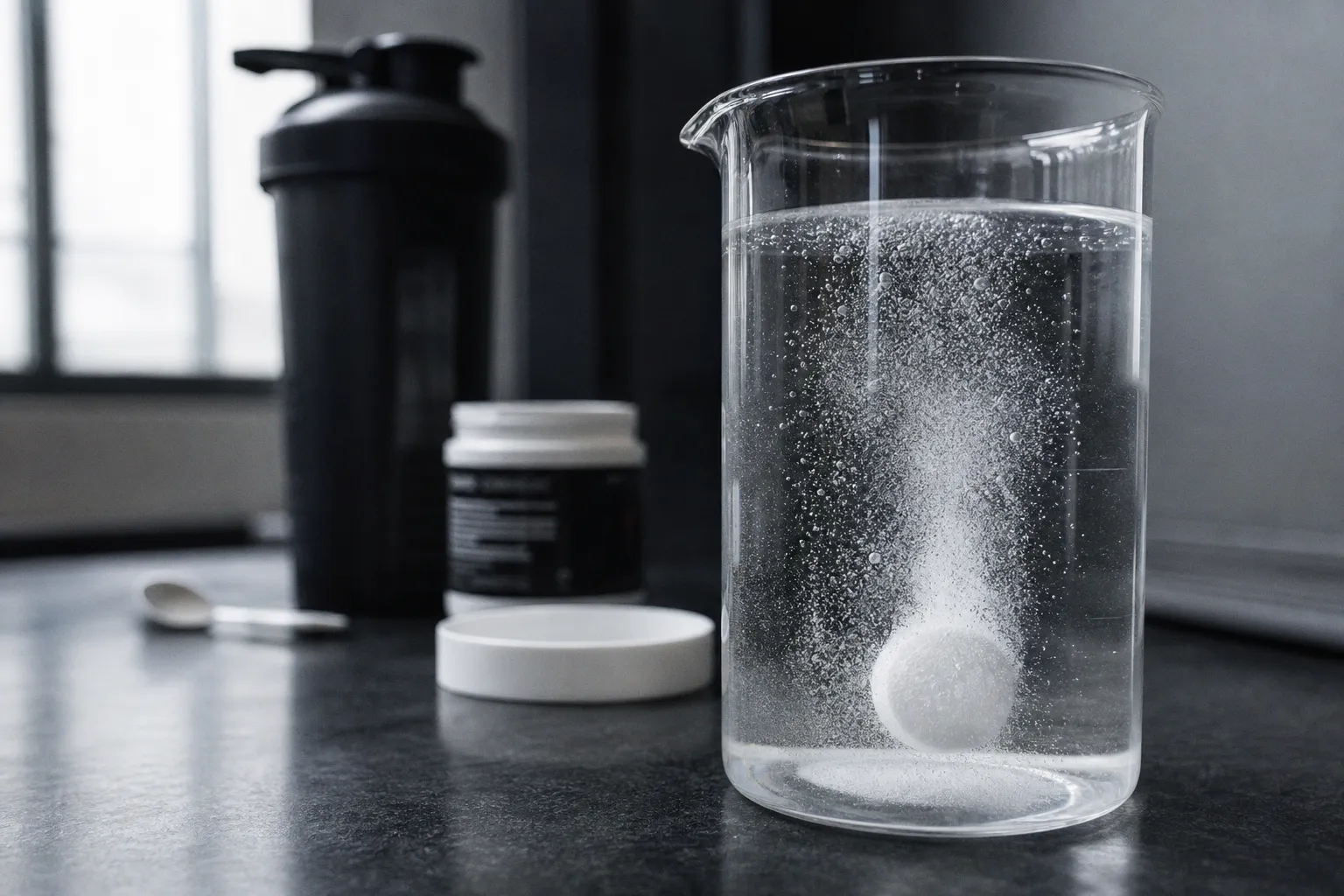
That is where sports supplements are usually misunderstood. They do not add energy in the caloric sense. They do not replace glycogen, sleep, or load management. The useful ones alter constraints inside existing energy systems. They improve substrate availability. They reduce perceived effort. They buffer hydrogen ions. They lower the oxygen cost of a given output. Small mechanisms. Large consequences when the session is built around them.
Cellular energy is not one system
Muscle contraction requires ATP. That statement is accurate and incomplete. The relevant question is how fast ATP can be resynthesized under a given workload.
A 1-repetition max attempt, a 30-second hill sprint, a 4-minute rowing interval, and a 90-minute ride do not stress the same pathway in the same ratio. They share ATP as the final currency. They differ in the machinery used to regenerate it.
For practical sports nutrition, three energy constraints matter most:
- ATP-PCr availability. The phosphocreatine system supports very high power output for short durations. It is central to sprinting, jumping, lifting, and repeated accelerations.
- Acid-base control. High-intensity glycolysis produces hydrogen ions alongside lactate. The problem is not lactate itself. The problem is the associated fall in pH, which impairs force production and contraction velocity.
- Oxygen cost and mitochondrial efficiency. Endurance work depends on producing ATP with oxygen. If the oxygen cost of a given pace drops, the athlete can hold the same output with less metabolic strain.
Sports supplements with real evidence tend to target one of these constraints. Creatine supports the ATP-PCr system. Caffeine modifies central perception and neuromuscular output through adenosine receptor antagonism. Beta-alanine and sodium bicarbonate buffer pH in different compartments. Nitrate can improve mitochondrial efficiency and reduce the oxygen cost of submaximal work.
The mechanism matters because the wrong supplement for the wrong session does little. Creatine will not turn a poorly fueled long run into a controlled aerobic session. Nitrate will not fix bad sprint mechanics. Caffeine can mask fatigue and make load management worse if the athlete uses it as a throttle override.
Supplements do not create force. They change the conditions under which force production degrades.
The ATP-PCr system and substrate availability
The ATP-PCr system is the fastest route for ATP resynthesis during maximal or near-maximal effort. It relies on phosphocreatine stored in muscle. When ATP is split during contraction, phosphocreatine donates a phosphate group to regenerate ATP rapidly.
This system has high power and low capacity. It is useful when the task demands high output immediately. A heavy triple. A 10-meter acceleration. A jump. A change of direction. A short wrestling exchange. The limitation is not motivation. It is substrate depletion and recovery kinetics.
During repeated high-intensity bouts, phosphocreatine stores fall. Resynthesis occurs during rest periods and depends on oxygen availability. If rest is too short or the session density is too high, the next effort starts with less available phosphocreatine. Peak power falls. Bar speed drops. Sprint time increases. Movement changes.
That is the mechanical link. Low phosphocreatine availability does not just show up in a blood marker. It changes output. It changes joint positions under fatigue. It changes how the athlete distributes load across tissues.
Creatine monohydrate works because it increases intramuscular creatine stores. More stored creatine supports a larger phosphocreatine pool. The effect is most relevant when the athlete repeats high-intensity efforts with incomplete recovery.
The common maintenance dose is simple: 3–5 grams of creatine monohydrate daily. Timing is less important than consistency. The tissue saturation model matters more than pre-workout timing. Creatine is not a stimulant. It does not need to be felt to be working.
For amateur athletes, the use case is usually not a single heroic lift. It is session quality across weeks. More total high-quality repetitions. Better preservation of output late in a set. More training volume tolerated when the program already has adequate recovery.
Creatine is not just a gym supplement
The evidence base for creatine monohydrate is strongest in high-intensity exercise capacity and lean body mass during training. That makes it relevant to strength training, team sports, sprint work, and hybrid endurance athletes who include resistance training.
The mistake is treating creatine as a bodybuilding-only product. Any athlete who needs repeatable force production should understand the mechanism. Acceleration requires high rate of force development. Jumping requires rapid impulse. Lifting requires intramuscular coordination under load. These are not separate from cellular energy. They are expressions of it.
Creatine does not improve technique. It does not manage tendon load. It does not repair a bad progression model. But it can support the energy system that allows quality work to be repeated.
Practical constraints remain:
- Body mass may increase. Some athletes gain scale weight from water stored with increased intramuscular creatine. This may matter in weight-class sports or running events where body mass changes the cost of locomotion.
- Daily dosing beats sporadic dosing. Taking creatine only before hard sessions misunderstands saturation. The target tissue needs repeated intake.
- The form does not need novelty. Creatine monohydrate remains the reference form. More complex labels do not create a better phosphocreatine system by default.
- Training context determines value. A cyclist doing only low-intensity base work may notice little. A field athlete in a repeated-sprint block has a clearer use case.
Caffeine and the nervous system constraint
Caffeine is often described as an energy supplement. That description is sloppy. Caffeine does not provide usable calories for muscular work. Its main ergogenic role comes from antagonism of adenosine receptors.
Adenosine signaling contributes to sleep pressure and fatigue perception. By blocking adenosine receptors, caffeine can reduce perceived effort and increase alertness. It can also influence motor unit recruitment and central drive. The result is not free energy. It is altered perception and output regulation.
The common performance range is 3–6 milligrams per kilogram of body mass, taken about 60 minutes before exercise. A 70-kilogram athlete is therefore looking at 210–420 milligrams. That is a wide range. The high end is not automatically better.
Caffeine has a narrow practical margin because the same mechanism that improves readiness can disrupt execution. Too much sympathetic arousal can degrade fine motor control, pacing, and sleep. For athletes training after work, the sleep cost can exceed the session benefit. Load management includes the next night.
Caffeine fits specific problems:
| Training problem | Caffeine may help | Caffeine may interfere |
|---|---|---|
| Heavy strength session after a low-arousal day | Higher central drive and lower perceived effort | Excess arousal can disturb bracing and setup consistency |
| Long endurance session at controlled intensity | Lower perceived exertion at the same output | Late-day use can impair sleep and recovery |
| Repeated sprint or interval session | Better willingness to sustain high output | Pacing errors if early efforts exceed the plan |
| Skill-dominant session | Sometimes useful for alertness | Tremor, rushed timing, poor decision speed under pressure |
| Deload or recovery session | Usually unnecessary | Masks fatigue signals the session is meant to observe |
The mechanical issue is simple. If caffeine lets the athlete produce more force than the tissue plan assumed, the session load changes. A programmed 5 sets at a controlled RPE can become a higher-stress exposure. That may be useful in a peak session. It may be a mistake in a tendon-sensitive block.
Caffeine is also highly individual. Habitual intake, body size, timing, and sleep sensitivity matter. The athlete should test it in training, not before a race or competition. A useful protocol tracks three variables: dose, session output, and sleep quality that night. If the performance gain is small and sleep cost is large, the intervention fails.
A supplement that improves today’s output while damaging tonight’s recovery has not improved the training week.
Buffering fatigue: beta-alanine and sodium bicarbonate
High-intensity efforts lasting roughly 1–4 minutes create a specific problem. Glycolytic flux rises. Hydrogen ion accumulation contributes to a fall in pH. Contractile function degrades. The athlete feels this as burning, heaviness, and loss of power. The useful term is not “lactic acid.” The useful concept is acid-base balance.
Two sports supplements target this problem from different compartments.
Beta-alanine increases muscle carnosine content. Carnosine acts as an intracellular pH buffer. It helps manage hydrogen ions inside the muscle cell. The standard daily dose is 4–6 grams, usually split into smaller servings because larger doses can cause paresthesia, the tingling sensation many athletes know from pre-workout products.
Sodium bicarbonate works outside the muscle cell as an extracellular buffer. It helps mitigate the drop in blood pH during anaerobic exercise. The common dose is 0.3 grams per kilogram of body mass. Its limitation is not theory. Its limitation is the gut. Gastrointestinal distress is frequent enough that testing is mandatory.
These are not general-purpose fatigue blockers. They have a performance window. They make most sense when the event or session produces severe acidosis: middle-distance running, rowing intervals, swimming repeats, combat sport rounds, hard cycling efforts, repeated high-output intervals.
They are less relevant to a 5-second sprint, where ATP-PCr dominates, or a low-intensity endurance session, where acid-base disruption is not the main limiter.
Intracellular versus extracellular buffering
The distinction is not academic. It changes how the supplement is used.
| Supplement | Primary mechanism | Typical dose | Best fit | Main constraint |
|---|---|---|---|---|
| Beta-alanine | Raises muscle carnosine for intracellular buffering | 4–6 g daily, split doses | Repeated high-intensity work lasting 1–4 minutes | Paresthesia; requires consistent use |
| Sodium bicarbonate | Extracellular buffer for blood pH | 0.3 g/kg | Acute anaerobic sessions or events | Gastrointestinal distress |
| Creatine monohydrate | Supports phosphocreatine availability | 3–5 g daily | Short maximal efforts and repeated high-power work | Possible body mass increase |
| Caffeine | Adenosine receptor antagonism | 3–6 mg/kg, 60 min pre-exercise | Endurance, strength, intervals | Sleep disruption, excess arousal |
| Nitrate | Improves oxygen cost and mitochondrial efficiency | 6–8 mmol nitrate, often ~500 ml beetroot juice | Submaximal endurance and sustained efforts | Individual response variability |
Beta-alanine is a chronic supplement. It works by increasing carnosine stores over time. Taking it only before a hard session because it produces tingling is a category error. The sensation is not the mechanism. The tissue concentration is the mechanism.
Sodium bicarbonate is acute. It can be used before targeted sessions. But the gut response can ruin the session. Athletes should test dosing, timing, and food context away from competition. For many amateur athletes, the practical problem is not whether bicarbonate works in a lab. It is whether they can tolerate it during warm-up, transport, and event stress.
There is also a load management point. Buffering allows more work in a highly fatiguing zone. That can be useful. It can also increase mechanical exposure. A runner who holds interval speed deeper into a session may accumulate more high-force contacts. A rower who sustains power longer may increase lumbar and rib stress. The supplement changes the workload the tissues actually receive.
Nitrate and mitochondrial efficiency
Nitrate supplementation, often through beetroot juice, targets a different constraint. It can improve mitochondrial efficiency and reduce the oxygen cost of submaximal exercise. The practical dose is often 6–8 mmol of nitrate, roughly equivalent to about 500 milliliters of beetroot juice, taken 2–3 hours before exercise.
The mechanism involves the nitrate-nitrite-nitric oxide pathway. Nitric oxide influences blood flow, muscle contractility, and mitochondrial function. The performance implication is straightforward: if a given pace requires less oxygen, the athlete operates with a lower relative cost.
This is relevant to endurance work. It may also matter in sports with sustained submaximal movement between high-intensity actions. But the strongest logic is not “more oxygen equals more performance.” It is reduced oxygen cost at a fixed output.
Nitrate has a practical detail that many athletes ignore. The oral microbiome participates in nitrate conversion. Antibacterial mouthwash can interfere with this pathway. Individual response also varies. The exact degree of variability in amateur populations is not fully predictable.
Nitrate is best treated as a controlled variable:
1. Use a consistent nitrate source. Beetroot juice shots and standardized products reduce uncertainty compared with random food intake.
2. Time the dose 2–3 hours before the target session. This matches the typical window used for acute effects.
3. Test at race-like intensity. Easy aerobic work may not reveal much. A tempo session, time trial, or controlled threshold interval is more informative.
4. Keep caffeine and new foods stable during testing. Otherwise the athlete cannot identify the active variable.
5. Record output and internal load. Pace, power, heart rate, RPE, and gastrointestinal response provide enough field data for a decision.
Nitrate is not a substitute for carbohydrate availability. A long session with low glycogen remains a long session with low glycogen. Improving oxygen cost does not solve substrate depletion.
Absorption is not the same as usefulness
Sports supplement absorption is usually discussed as if uptake alone determines value. That misses the sequence. A compound must be absorbed, reach the relevant compartment, alter a limiting mechanism, and match the demands of the session.
Creatine requires muscle saturation. Caffeine requires timing around plasma concentration and the training task. Beta-alanine requires chronic intake and carnosine accumulation. Sodium bicarbonate requires tolerable blood buffering without gastrointestinal failure. Nitrate requires conversion through a pathway affected by oral bacteria and timing.
The same supplement can be useful, irrelevant, or counterproductive depending on session architecture.
A strength athlete in a hypertrophy block may use creatine daily and caffeine selectively for top-end sessions. A recreational runner preparing for a 10K may test nitrate before threshold work and avoid bicarbonate unless intervals produce severe acidosis. A field sport athlete may benefit from creatine for repeated accelerations but should avoid using caffeine to push every practice into a higher-output day.
The physiological effects of sports supplements are not independent from programming. They modify the stress response. Programming determines whether that modification has value.
Match the supplement to the bottleneck
A simple diagnostic model is more useful than a supplement stack.
- If output falls in short repeated bursts, examine phosphocreatine support, rest intervals, and creatine consistency.
- If effort feels centrally limited despite adequate fueling and recovery, caffeine may help, but sleep response sets the ceiling.
- If performance fails in 1–4 minute high-intensity efforts, buffering strategies become relevant.
- If endurance pace costs too much oxygen at submaximal intensity, nitrate is plausible.
- If the athlete is under-fueled, sleep-restricted, or overloaded, supplementation is secondary. The bottleneck is not cellular assistance. It is system recovery.
Stacking several products without identifying the limiter creates noise. Creatine, caffeine, beta-alanine, bicarbonate, and nitrate all have plausible mechanisms. Their long-term combined effects in amateur athletes are less clear. More variables also make field testing worse. If performance changes, the athlete cannot identify why.
The better approach is sequential. Add one intervention. Hold training stable. Measure the relevant output. Remove or keep based on data.
How sports supplements work inside a training week
The useful question is not “Does this supplement work?” It is “What does it change in this week’s loading pattern?”
Consider a common amateur schedule:
- Monday: lower-body strength
- Tuesday: interval run
- Wednesday: mobility and easy aerobic work
- Thursday: upper-body strength
- Friday: rest
- Saturday: long endurance session
- Sunday: field sport or mixed conditioning
Creatine can sit in the background every day. It supports repeated high-intensity capacity across strength and field work. No acute decision is required.
Caffeine should be placed more carefully. Monday strength may justify a moderate dose if the session contains high-force work. Tuesday intervals may justify it if sleep is protected. Sunday field sport may not need it if decision speed and pacing matter more than arousal. Caffeine after mid-afternoon becomes a recovery decision, not a performance decision.
Beta-alanine requires daily intake if the athlete is in a block with hard intervals or sport rounds. It does not need to be tied to the session minute by minute.
Sodium bicarbonate belongs only near selected high-acidosis sessions after tolerance testing. It is not a casual pre-workout ingredient for an athlete with an unpredictable gut.
Nitrate can be tested before Saturday endurance work or Tuesday threshold intervals. It should not be evaluated on a chaotic day with poor sleep, heat stress, and an unusual breakfast.
This is the main difference between sports science and supplement marketing. Marketing treats the product as the event. Training treats the product as one input in a system.
A protocol for evidence-based use
A clean protocol removes most errors. It does not require laboratory testing. It requires restraint.
First, define the performance bottleneck. Use session data, not mood. Bar speed falls. Sprint split drops. Pace at a given heart rate worsens. Interval power collapses after rep four. These are observable outputs.
Second, select one supplement with a mechanism that matches the bottleneck.
Third, use a known dose:
| Goal | Supplement | Dose and timing |
|---|---|---|
| Repeated high-force efforts | Creatine monohydrate | 3–5 g daily |
| Reduced perceived effort or higher central drive | Caffeine | 3–6 mg/kg about 60 min pre-exercise |
| High-intensity efforts lasting 1–4 min | Beta-alanine | 4–6 g daily, split doses |
| Acute anaerobic buffering | Sodium bicarbonate | 0.3 g/kg after tolerance testing |
| Lower oxygen cost during endurance work | Nitrate | 6–8 mmol nitrate 2–3 h pre-exercise |
Fourth, track the correct outcome for two to four weeks. Creatine and beta-alanine need longer observation than caffeine or nitrate. Sodium bicarbonate needs tolerance testing before performance testing.
Fifth, watch the second-order effects. Sleep. Gut response. body mass. pacing. soreness. The supplement that improves a single session but worsens the next two sessions is a poor intervention.
Finally, remove the product if the mechanism does not match the result. There is no need to defend a supplement because it has a strong evidence base in another context. Evidence supports a mechanism. The athlete still has to match that mechanism to the task.
Sports supplements can improve cellular energy delivery by supporting phosphocreatine availability, modifying fatigue perception, buffering pH, or improving oxygen cost. That is the narrow claim. It is also the useful one.
The practical protocol is fixed: identify the limiter, choose one mechanism, dose it correctly, test it against session data, and keep it only if total weekly output improves without damaging recovery.
FAQ
How much creatine monohydrate should I take daily?
When is the best time to take caffeine for exercise?
Why do I feel a tingling sensation after taking beta-alanine?
Can I use sodium bicarbonate to improve my performance?
Does nitrate supplementation work for all types of exercise?
By Duncan Reed