Fitness tracker ring: is it worth it for athletes?
You're standing in front of the squat rack, fresh off the cleanest sleep score your fitness tracker ring has ever shown you. Resting heart rate: beautifully low. Heart rate variability: balanced and resilient.
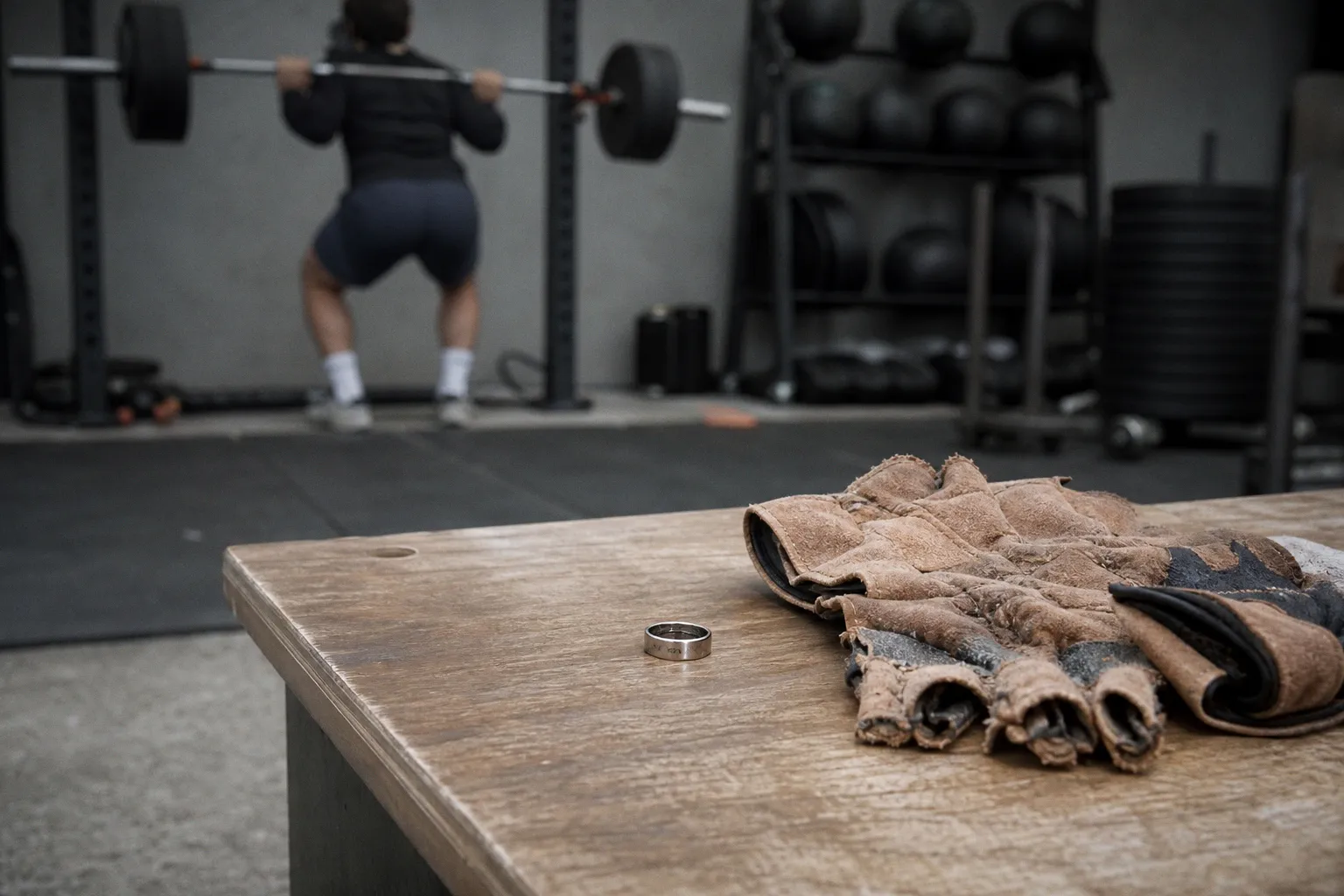
That gap — between the elegant precision of your ring's resting data and its scrambling behavior during real athletic work — is the question we're going to walk through together. Because the smart ring category has matured fast, and the marketing tends to flatten what is actually a fairly nuanced physiological story. As a rehab specialist who works with recreational athletes every week, I'll tell you plainly: these devices are extraordinary recovery tools and, in many cases, surprisingly limited training tools. Understanding that difference isn't about declaring winners. It's about listening to the device honestly so it can actually serve the way you move.
A ring on your finger knows you best when you're still. Asking it to keep up with a barbell is a different physiological conversation.
The clinical precision of resting metrics
Let's start where rings genuinely shine, because the technology has earned its reputation here. When your body is at rest — lying in bed, breathing slowly, not moving much — a smart ring can collect physiological data with a fidelity that genuinely impresses clinicians. A December 2025 systematic review found correlations of r² = 0.996 for heart rate and r² = 0.980 for heart rate variability compared to medical-grade reference devices. Translated out of statistical language: those are essentially the same numbers a clinical ECG would produce, almost every time.
For athletes, this is the part of the data story that actually matters for adaptation. Recovery isn't a vague feeling. It lives in measurable physiology — the variability between your heartbeats, the depth and architecture of your sleep stages, the drift of your resting heart rate across a training week. The ring sits on your finger all day and all night, sampling these signals passively, which means it captures the kind of longitudinal data a chest strap or wrist-worn optical sensor simply can't, because you'd never wear those to bed. The Oura Ring 5, released in early June 2026 after a May 28 announcement, dropped to 2.28 mm thick and trimmed roughly 40 percent off the volume of its predecessor, which is part of why people tolerate it overnight. Battery life of six to nine days means you're not charging it like a phone, and the device is unobtrusive enough that you forget it's there.
What this gives you, practically, is a moving picture of your tissue tolerance — your body's capacity to absorb the next training stress without breaking down. If your HRV is trending down for three days in a row, the ring is showing you, in the language of your nervous system, that something is asking more of you than you're currently paying back. This is the part of the value proposition that holds up. We can trust the ring when we're still, and that trust compounds week over week.
The motion artifact gap
Now let's talk about what happens when you start moving. The same small, elegant sensor that captures clean resting signals begins to behave very differently when your hand is swinging, gripping, or compressing against a bar. This is the world of motion artifacts, and it's the single biggest limitation of the fitness tracker ring form factor.
Optical heart rate sensors — the green or infrared LEDs that most rings use — work by shining light into the skin and measuring the changing blood volume underneath. The math is simple in principle. The reality is messier. When the sensor is bouncing against tissue, when blood is being squeezed out of the fingertip by a heavy deadlift, or when your hand is gripping a pull-up bar hard enough to blanch your knuckles, the optical signal gets corrupted. The device can confuse mechanical pressure for vascular pulse, or miss the pulse entirely while the wrist is locked in a tight fist. During high-intensity intervals, the ring tends to underestimate heart rate — sometimes by a wide margin — because the algorithm is reading noise that resembles a slower pulse.
If your sport is steady-state endurance running on flat terrain, this gap is smaller. A ring on your finger while jogging produces data that is directionally useful, particularly for easy aerobic work. But the moment the movement becomes explosive, asymmetrical, or involves gripping, the data drifts. We have all seen athletes post screenshots of their ring's heart rate during a hard lift next to a chest strap from the same session — the chest strap reads 165, the ring reads 138, and the athlete is left wondering which one to trust. The honest answer is the chest strap. Wrist-based optical sensors do this better than rings because the wrist has more soft tissue and a more stable contact patch. Rings have neither advantage.
| Scenario | Ring accuracy | What to know |
|---|---|---|
| Overnight resting HR | Excellent | Correlation near r² = 0.996 versus medical-grade ECG |
| Sleep stages & HRV | Excellent | Continuous passive monitoring is the form factor's strength |
| Steady-state running | Directional | Useful for trends, less reliable second-to-second |
| HIIT, sprints, plyometrics | Poor | Motion artifacts dominate the optical signal |
| Strength training with grip | Poor | Compression of tissue disrupts readings |
| Cycling (especially drops) | Poor | Variable grip and vibration both interfere |
The ring reads your stillness beautifully. It reads your effort less reliably — and that distinction matters for how you train.
Safety and durability in the weight room
There's another conversation that glossy product pages don't always have, and as a clinician I think it's the one worth having openly. Putting a piece of jewelry on your hand and then asking that hand to grab a loaded barbell introduces a category of risk that doesn't exist with a wrist-worn device.
The first is mechanical. Most premium rings use titanium or titanium alloys for their outer shells, which are strong but not immune to scratching. A loaded barbell has a way of finding the soft edges of jewelry, and over time the sensor window — that small flat surface on the inside of the ring — can develop microabrasions that degrade optical accuracy. Manufacturers will tell you the ring is scratch-resistant, and that's technically true; it is not scratch-proof, and the inside surface, where the sensor lives, is the part that cannot be polished away without ruining the device.
The second concern is more serious, and it has a name in the clinical literature: ring avulsion injury, sometimes called a degloving injury. When a ring catches on a piece of equipment — a kettlebell handle, a pull-up bar, a climbing rope — and the rest of the hand continues moving, the soft tissue of the finger can be stripped. The injuries range from lacerations that heal in weeks to amputations that do not. They are rare. They are also exactly the kind of rare event worth a thirty-second conversation before you train. The same risk exists for any metal ring, and many gyms already discourage loose jewelry near loaded movements. A smart ring, in this respect, is no different from any other ring. We just tend to forget it's there because it looks like part of us.
The third is compression. When you grip a bar tightly during a heavy set, the soft tissue of your finger deforms. The ring presses into skin, sometimes pinching, sometimes leaving a groove that takes an hour to fade. For most athletes this is a minor annoyance. For anyone with circulation issues, neuropathy, or swelling in the fingers, it can be a real problem. Listening to the joint — and to the skin, and to the small nerves underneath — means paying attention to whether the ring is creating a hotspot you keep choosing to ignore.
Real-time feedback: the screenless trade-off
Here's where we move from physiology to design, and design choices are rarely neutral. A fitness tracker ring, by definition, has no screen. No vibration motor for tap alerts. No glanceable display telling you your pace, your heart rate zone, or how long you've been in zone three. Everything the ring knows, you find out by taking your phone out of your pocket, opening the app, and waiting for the data to sync.
For recovery, this is fine. Recovery happens between sessions. You check it at breakfast. For active training, it's a meaningful loss. The entire point of training with a heart rate monitor is the conversation between effort and adaptation in real time. If your interval is supposed to be at 85 percent of max and your ring is telling you, three minutes after the interval ends, that you spent the whole thing at 72 percent, the moment to do anything about it is gone. You can adjust next time, sure, but you can't adjust this time. Real-time feedback loops are part of what makes wearable data actually change behavior.
This is the structural reason most coaches and performance staff pair a ring with a wrist-based sports watch or a chest strap. The ring handles the passive, longitudinal story — sleep, recovery, readiness, illness detection. The watch or chest strap handles the active, second-by-second story — pace, heart rate zones, power output, interval pacing. They are not competing devices. They are answering different questions. A watch on your wrist will never be as comfortable to sleep with as a 2.28 mm ring. A ring on your finger will never be as informative during a track workout as a chest strap against your sternum. Each tool, like each joint, has a job it was shaped for.
Ecosystem lock-in and the hidden costs of subscription models
The last thing worth your attention is the business model, because it shapes which data you actually get to see. A smart ring in 2026 is rarely just a device. It's the front end of a software platform, and the platforms have decided, with very few exceptions, that the software is where the money is.
The most established player in this space, Oura, charges $5.99 per month or $69.99 annually for full access to the data their hardware has already collected. The Oura Ring 5 is a beautiful piece of engineering, and the subscription that unlocks its full feature set is also the most expensive in the category. Competitors have moved in the other direction. The Samsung Galaxy Ring and Ultrahuman Ring Air both offer subscription-free access to their core metrics, which is a real consideration for an athlete on a multi-year training plan. The Galaxy Ring, however, only works with Android — and is optimized for Samsung handsets in particular — which is a hard ceiling for anyone in the iOS ecosystem. Oura and RingConn Gen 2 both support iOS and Android, which keeps your options open if you ever change phones.
The pattern here is worth naming. When you buy a ring, you're also choosing a data ecosystem, a recurring cost, and in some cases a phone platform. If you stop paying the subscription, the ring still works as a ring. It just stops working as a fitness tracker. We have seen this story before in the industry, and it has never ended with subscriptions getting cheaper over time. Build the cost into your decision now, not later, the way you'd build the cost of shoes over the next 500 miles of training.
| Factor | Oura Ring 5 | Samsung Galaxy Ring | Ultrahuman Ring Air |
|---|---|---|---|
| Platform support | iOS + Android | Android only | iOS + Android |
| Monthly fee | $5.99 | None | None |
| Battery life | 6–9 days | ~6 days | 6–7 days |
| Water resistance | 100 m | 100 m | 100 m |
| Real-time workout screen | No | No | No |
| Resting HR / HRV accuracy | High | High | High |
So is it worth it?
The honest answer depends on what you're asking the ring to do, and that answer is rarely all-or-nothing.
If you are an athlete who wants a quiet, continuous picture of your recovery — sleep architecture, resting heart rate trends, HRV week over week, illness detection, readiness scoring — the fitness tracker ring is one of the best tools ever made for that job. The Oura Ring 5, the Samsung Galaxy Ring, the Ultrahuman Ring Air, and the RingConn Gen 2 all do this well, and the form factor genuinely changes the kind of data you can collect, because you'll wear it through the night without thinking about it. The clinical-grade accuracy at rest is real, the longitudinal picture is genuinely useful, and the device will probably outlive your next two training cycles.
If you are an athlete who wants a single device to track both recovery and active training, you will be disappointed. The motion artifact problem, the lack of a screen, the compression and safety issues in the weight room, and the inability to deliver real-time feedback all add up to a category ceiling that has not been broken yet. For active training, a GPS sports watch or a chest strap is still the right tool. Not because rings are bad, but because the physiology of optical sensing through a thin finger joint during a loaded movement is fundamentally different from the physiology of a chest strap against your sternum.
My suggestion, sitting here in the clinic with you, is to think of these as complementary instruments rather than competitors. A ring for the long story your body tells while it's still. A watch or chest strap for the short story your body tells while it's working. Each is honest about what it knows. Neither one is a substitute for learning to listen to how you actually feel during a hard set, because no sensor on earth has caught up to your own perception of effort, breathing, and form yet. The tools are getting smarter every year. The athlete still has to be the one paying attention — and that, over the long arc of a training life, is the habit that actually moves the needle.